
Designing Aesthetics of Intelligence
Stephan A. G. Wensveen
Department of Industrial Design, Eindhoven University of Technology, Eindhoven, the Netherlands
Design and aesthetics have always been in a relationship with emerging technology and materials, as each advancement in technology offered and required new opportunities for design and aesthetics. In this piece I want to offer my perspective on how Artificial Intelligence and its technologies can relate to design and aesthetics. Through design exemplars, I will trace my own journey and aesthetic values across three previous waves of design aesthetics: appearance, interaction, and transformation, to arrive at a fourth wave of ‘aesthetics of intelligence’. I will propose five principles that might help to offer an aesthetic compass for navigating these challenging times.
Keywords – Aesthetics, Artificial Intelligence, Perspective.
Relevance to Design Practice – This perspective is relevant for practitioners, as it provides a vocabulary to discuss the aesthetics of intelligence and a direction to give form to. The perspective is exemplified with plenty of design (research) projects and images.
Citation: Wensveen, S. A. G. (2026). Designing aesthetics of intelligence. International Journal of Design, 20(1), 83-91. https://doi.org/10.57698/v20i1.08
Received March 27, 2026; Accepted April 20, 2026; Published April 30, 2026.
Copyright: © 2026 Wensveen. Copyright for this article is retained by the authors, with first publication rights granted to the International Journal of Design. All journal content is open-accessed and allowed to be shared and adapted in accordance with the Creative Commons Attribution 4.0 International (CC BY 4.0) License.
*Corresponding Author: s.a.g.wensveen@tue.nl
Stephan Wensveen is a full professor of Constructive Design Research in Smart Products, Services and Systems at Industrial Design (TU/e). He studied Industrial Design Engineering (MSc, PhD) at TUDelft. In 2002 he joined ID (TU/e). He has always been interested in using the power of design to integrate research, education, and innovation, co-establishing the /d.search-labs (2006) and the Wearable Senses lab (2008). He is co-responsible for canonical examples and approaches to Research through Design. His most recent interest is in the development of designers’ competence in aesthetics of intelligence.
Introduction
When you ask ten people their definition of aesthetics, you probably get ten different answers. Here is mine. I see aesthetics as a critical reflection on how people create, use, enjoy, or dislike design. I believe that aesthetics is fundamental to understand how designed technology affects people’s emotions, their understanding of the world, and their attitude towards life. In this perspective, the focus is on aesthetics that relate to industrial- and interaction design.
I also like how Alva Noë (2023) talks about how aesthetics “…moves us from not seeing to seeing, and from seeing to seeing differently,” and how aesthetics can disrupt our habits while also creating and suggesting new habits.
Aesthetics of Appearance
In the late 1980’s I was a first-year student in Industrial Design, and a lot of my peers were fascinated and inspired by Dieter Rams and the minimalist aesthetics of Braun products. His 10 principles from the late 1970’s seemed the right, or the only way (Vitsoe, n.d). For example: ‘5. Good design is unobtrusive, or 10. Good design is as little design as possible.’ I felt out of place with these principles and its minimalist aesthetics, and somewhat lost. In my 2nd year I followed a group of seniors to an exhibition in the Groningen Museum, and what I saw blew my mind. A wild sofa in the boldest of colours, an impressive room divider with thick diagonal shelves and an almost tacky texture of laminate, and many more crazy designs. “Wow, was this allowed?” “Could I do this too?” The exhibition was an overview (1981-1988) of Memphis, the radical Italian design movement (Ter Hofstede, 1990). Later, I realized how their aesthetics resonated so well with my personal influences of skate magazines, 80’s surf culture, and design radicals such as graphic designer David Carson for Transworld Skateboarding (1984-1987), Beach Culture (1989), and Quiksilver artist Peter Webb and their Warpaint collection (1987).
I took my inspiration from the values of these countertrends and cultures and their attitude to challenge the status quo. In my own designs I aimed for bodily, physical actions and emotionally expressive freedom, being inspired by riding waves or skating the affordances of street furniture.
In our design studies we did ‘form giving’ exercises, focusing on the formal qualities of aesthetics of appearance: shape, color, texture, proportion, and on understanding the relationship between aesthetic form, materials (clay, wood, metal and plastics), and their manufacturing technologies. New (manufacturing) technologies had shaped design aesthetics and iconic designs, e.g., bending beechwood to produce the delicate curved lines of a Thonet chair, or the organic shape and the vibrant red color of the first all-plastic Panton chair in the 1960’s made possible by the new material of fibreglass and the manufacturing technologies of the Vitra company.
After my graduation I tried to be a full-time surfer, didn’t succeed, went back to academia, and started my PhD studies.
Aesthetics of Interaction
At that time, in the early 2000’s, industrial design went through a paradigmatic shift. This shift was made possible and even necessary with the advancements in technology. The main technological advancements were no longer in the physical materials and production technologies, but came from the breakthrough in and accessibility of information technologies, digital electronics, and interactivity as a material. Products were equipped with screens, buttons, and menu structures, and interaction required cognitive skills, with usability being the main focus. Our research group revolted against that status quo with our pamphlet of 10 principles (Djajadiningrat et al., 2000), which included ‘1. Don’t think products, think experiences.’ ‘2. Don’t think beauty in appearance but think beauty in interaction’, and ‘3. Don’t think ease of use but think enjoyment of the experience’. We were not alone in making that shift, Anthony Dunne in the UK was talking about ‘aesthetics of use’ (Dunne, 1997) and Lars Hallnäs and Johan Redström we’re talking about the ‘aesthetics of computational artefacts’ and ‘aesthetics as the proper foundation for technology design moving from efficient use to meaningful presence’ (Hallnäs and Redström, 2002).
While the design materials were changing, our aesthetic compass kept course. In our design research group Design Quality in Interaction (DQI) we critiqued the status quo of focussing on efficiency and the cognitive approach in interaction. Instead, we explored the relationship between form-giving and tangible (inter)action with prototypes for a video-recorder, a camera, and an alarm clock (Djajadiningrat et al., 2004). With the last one we demonstrated that freedom of bodily interaction leads to freedom of emotional expression, and products could learn from that (Wensveen et al., 2002). This work was continued by Philip Ross (Ross and Wensveen, 2010), who further researched the relation between values, ethics, and aesthetics, and designed different interactions within a light fixture to relate to the diversity of people’s values.
Because of the new design materials, interaction design and UX/UI design came up as new disciplines next to industrial design. Key commercial examples from that interaction era are the iPod and iTunes system (2001), the Nest thermostat (2011), or the Philips Hue light system (2012). And instead of talking about colour, proportion, and texture, designers were discussing the qualities of ‘spatio-temporality’ (Lenz et al., 2017), ‘expressivity in interaction’ (Bruns et al. 2021), and training their sensitivity for different ‘modalities’ or ‘interaction gestalts’ (Lim et al., 2007).
Aesthetics of Transformation
Moving ahead in time, in 2010, 15 years ago, design shifted towards a more social perspective (Chen et al. 2016), with sub-disciplines like critical design, social design, and design activism. With that shift a new, maybe smaller, wave emerged: aesthetics of transformation. Ilpo Koskinen expressed: “when the attention of design shifts to social forces, aesthetic concepts tied to products lose a great deal of their relevance” (Koskinen, 2016). He identified different aesthetic strategies in social design, one of which was disruptive aesthetics (Markussen, 2013). He talked about aesthetic acts, how they reorient perception and action and can thereby disrupt the social culture forms of the everyday world, leading to aesthetics with the political potential to transform existing systems of power.
Five years ago, in the 2020’s I realised that we needed another change for the role of aesthetics. Smart thermostats and speakers were perhaps the first AI-products that became commercially popular. They were designed with an aesthetics of appearance inspired by Braun, having nice shapes and materials that fit in the home. Their interactions were designed with proper UX and social aesthetics, and yet something was off. The new technologies of speech recognition, recommender systems, and underlying machine learning algorithms had also shaped a fundamentally new layer of aesthetics.
Aesthetics of Intelligence
So, this brings us to the fourth wave: aesthetics of intelligence. While the focus of the IJDesign perspective is on artificial intelligence, I like to see intelligence as a system, a combination of multiple types of intelligence, whether they are artificial, human, biological, or socio-cultural intelligence.
On the lowest system level, intelligence can be seen as a technical system. But as soon as people are interacting with it, it becomes part of a social-technical system. And if more people are using it over longer periods of time, it becomes part of a social-cultural system and eventually a natural-cultural system (Figure 1).
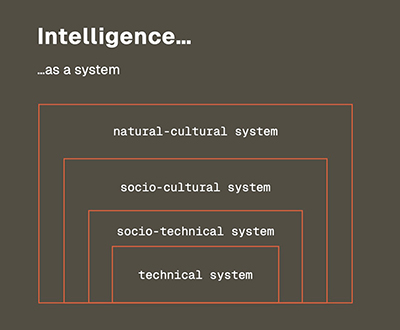
Figure 1. Intelligence as a system with different system levels.
To gain a better understanding of what aesthetics of intelligence is, or how it can be shaped, I have made an analogy to the other aesthetic waves. The aesthetics of appearance and of interaction are shaped by their formal qualities (e.g., color and texture, or temporality and modality). But what are the formal qualities of intelligence? Looking at different designs and researching different literature, I came up with the following five qualities of intelligence: uncertainty, instability, agency, intentionality, and emergence. And to make them a bit more challenging and inspiring for design, I used these formal qualities of intelligence and combined them with ‘designerly verbs’, forming what could be called principles. Each principle is exemplified by a design vignette. These design vignettes are chosen as they align with my compass values of challenging the status quo, physical and bodily interaction, and emotional expression.
Principle 1: Forming Uncertainty
Uncertainty is a key quality within the probabilistic properties of machine learning. Often, engineers and developers aim to lower the uncertainty within technical systems. However, as designers we can also try to give form to the beauty of uncertainty. Uncertainty can bring positive emotional experiences through the element of surprise, or trigger curiosity, and uncertainty can move one to reflect, explore, and generate.
I was inspired by the work of Jesse Benjamin et al. (2021), who wrote about machine learning uncertainty as a material. When designers start treating uncertainty as a material, then it also can have material qualities and maybe even aesthetic qualities. The following design vignette (Figures 2, 3, and 4) shows how an inspired designer, Sam Theelen, explored the aesthetic potential of the uncertainties that are inherent in generative AI tools (Theelen et al, 2026).
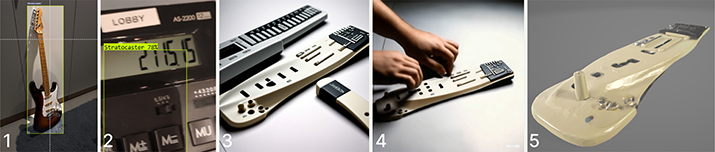
Figure 2. Digital workflow of the Calcucaster. 1: training an Object Detection model on Stratocasters, 2: false positive recognition on a calculator, 3: image generation of a calculator guitar, 4: video generation, 5: 3D model generation.
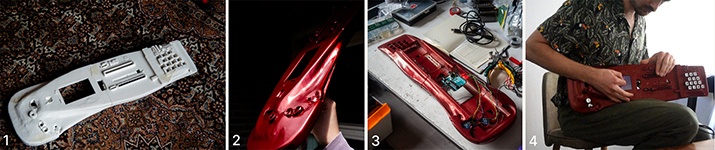
Figure 3. Physical workflow of the Calcucaster. 1: printed 3D model, 2: finished 3d model, 3: installing sensors and actuators, 4: affordance mapping to functions by testing.
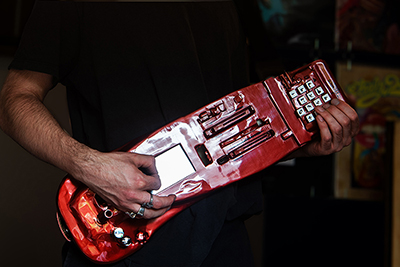
Figure 4. N̴OIO̷B̴V̷K̷̤̞̘͎̣͂͆͗̑͆̇ҜA̴C Calcucaster by Sam Theelen (2026).
Principle 2: Caring for Instability
Where uncertainty deals more with perception and knowing, instability deals more with action and doing within systems. To structure and direct the design of (in)stable systems I combined it with the contemporary post-human concept of ‘caring’ (Oktay et al., 2024), especially as natural and social systems are no longer stable and deserve caring for their instability. Therefore, the second principle is ‘caring for instability’. We can care for instability at different system levels, e.g., hardware failure as an instability of the technical system, AI bias within a socio-technical system, democracy as an unstable socio-cultural system, and even the lack of biodiversity within a natural-cultural system, all of which are systems that demand care from designers.
In the following vignette Missjourney (ACE, 2023) shows a critical design proposal that addresses, challenges, and counters the inherent bias in image generators.
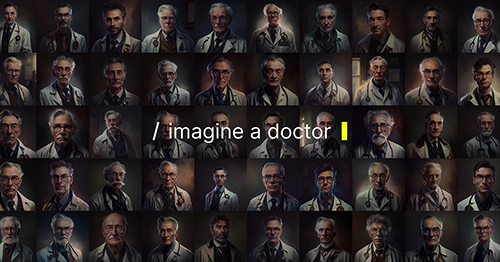
Figure 5. Missjourney (ACE, n.d.): Example of AI gender bias where an AI generates stereotypical images.
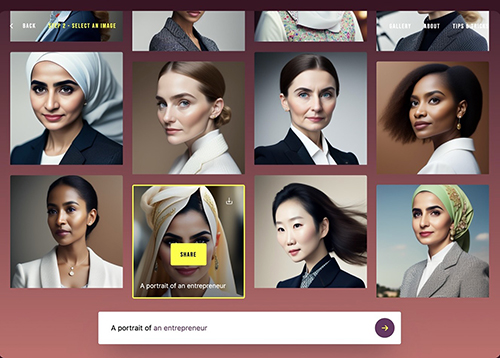
Figure 6. Missjourney's Webinterface. “MissJourney is the world’s first AI text to image generator that celebrates women. The user-friendly AI tool was built to combat AI gender bias and has a built-in logic that helps AI to create anti-stereotypical prompts. When it is asked to imagine a portrait of a CEO, athlete, or leader, rather than producing the usual male stereotype examples this AI tool creates diverse female-led artworks" (ACE, 2023).
That care for instability can also go absurdly wrong is clear from the example of Google Gemini in 2024 when they tried to compensate for gender and racial representation bias in AI, and the system was creating ahistorical images of coloured and female Nazi soldiers (Stjernholm et al, 2025).
Principle 3: Harmonising Agencies
The third principle is about harmonising agencies. This principle acknowledges that complex intelligent systems function through a multiplicity of agents, each with different capacities and powers that act on each other. Human agents have perception-motor skills, as well as cognitive, emotional, and social skills, and are thus capable of much more than typing AI prompts. The key capacities of machine agents are detecting, predicting, identifying, or generating text, images, or other modalities. Beyond humans and machines, we can identify material agents that can exert power by allowing or constraining the actions of other agents (e.g., affordances). Institutional agents (organisations, companies etc.) also exert power through, e.g., business models, legislations, policies, and other normative practices.
The multiplicity and diversity of agents show that the concept of human-ai collaboration and ‘balancing’ the human with the AI might be too narrow. Instead, the principle of ‘Harmony’ is chosen, an intuitive concept within aesthetics that helps designers to make sense of and create order within complex systems. Harmony is the principle to create “union in cooperating elements” (Lomas & Xue, 2022), and can be seen as “…the result of contraries (between agents), for it is the unity of multiplicity and the agreement of discordances (between these agencies)” (p. 13).
The following vignette shows how the multiplicity of agencies (e.g., human, machine, planetary) within a smart home infrastructure can be harmonized into a unified system.
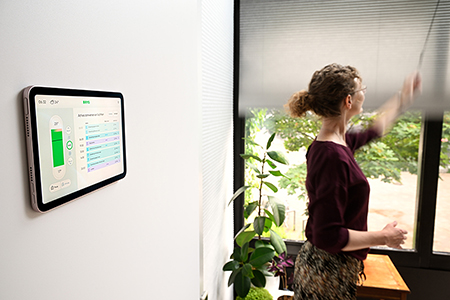
Figure 7. Brys is a design proposal for an open-access smart thermostat by Kuijer (2024). Instead of focussing on full automation and full machine agency to operate an HVAC (heating, ventilation, air conditioning) system, she’s challenging the balance between human learning and effort, and convenience and system automation. (Image by Bart van Overbeeke)
Brys acknowledges that multiple agents are at play in a smart home system. Next to the humans and HVAC technology, sunlight and outdoor temperature also have agency on the indoor climate. Their representative machine agents can predict their influence and inform the thermostat. Instead of a fully automated indoor climate, people are expected to invest some physical effort (physical agency), thereby gaining a more embodied understanding of how their home reacts to sunlight and outdoor temperatures in different seasons.
The motivation for this project was found in another principle, caring for the instability, not just for the home system, but in caring for the instability of the planetary system. The project is also a search for eco-harmony, a countertrend against techno-hedonism (Kuijer and Laschke, 2024).
Another example of harmonizing human-AI interaction can be found in the research on playful placemaking (Huang et al. 2026), where the agencies need to be harmonized between human players, Generative AI, other citizens, and the urban landscape.
Principle 4: Expressing Intentionality
The fourth principle is expressing intentionality. Agents don’t just have capacity as they are also trained or designed with purpose, intent, and direction towards others. This intentionality of the different agents can be expressed, but it can also be hidden.
Figure 8 shows how the exchange of intentionality is expressed between a human user and an automated vehicle. Expressing the intentions of an automated vehicle to pedestrians was further researched in Dey et al., (2021).
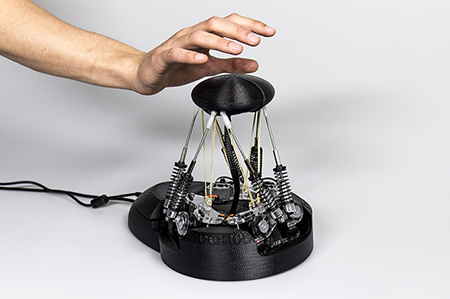
Figure 8. Stewart a haptic interface. In a project by Felix Ros (in Terken et al., 2016), a haptic interface named Stewart was developed allowing the user to sense and physically influence the behaviour and intentions of a fully automated vehicle. A form of haptic interaction was chosen since it was believed that it would be a non-obtrusive way to communicate the car’s intention and also provide opportunities to indirectly influence the car’s driving behavior. When driving, Stewart should enable people to do something else besides driving while providing a sense of control over the car’s behavior.
That intentions of agents can also remain hidden is shown in the work of Sabrina Hauser, who together with co-authors (Hauser et al., 2023) talked about the rift between appearance (expressions) and true character (intentions), and the rift between the design aesthetics and the design ethics.
Figure 9 shows a Braun product from 1960, a record player and two speakers. They appear as a record player and two speakers, and that is also what they do: a device that plays music records, and two speakers that play the sound of that music.
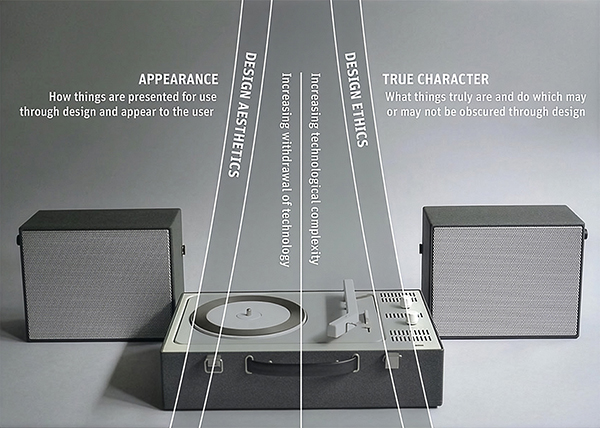
Figure 9. The design analysis with Braun Speakers from 1960 designed by Dieter Rams (Hauser et al., 2023, p. 229).
Figure 10 also shows a record player and two speakers, but the two speakers can actually do much more than play the sound of the music record. These ‘speakers’ can listen to conversations, they can talk back to humans and provide suggestions for them, and so much more. However, the aesthetics are not expressing these characteristics. Even stronger, the aesthetics seem to specifically hide the true intentions of the company behind this system.
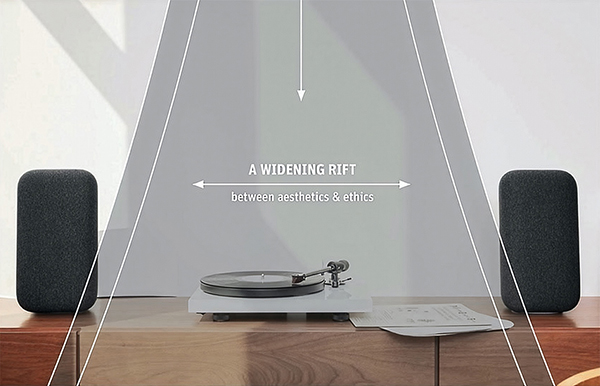
Figure 10. The design analysis with Google Home Max smart speakers from 2017 (Hauser et al., 2023, p. 229).
Principle 5: Anticipating Emergence
The fifth principle is more focussed on the consequences of what designers do, and what might happen if we design smaller technical systems into the larger existing socio-technical systems of the world. When these smaller parts start to interact with each other, with other systems, and in a wider whole, it can lead to the emergence of new entities with properties that the separate systems did not have on their own. While these entities or phenomena cannot really be predicted, designers should feel responsible for the anticipation that emergence of unexpected events will happen. These unexpected future events can become large, consequential, and hard to reverse, like the effect of AI tools on our socio-cultural systems, or the effect of the ‘necessary’ AI datacentres on the natural-cultural system. Emergence can be small, like an everyday crisis or a micro breakdown with negative consequences, but can also be positive.
Five Principles Working Together
The five principles for the aesthetics of intelligence are presented as separate, but should be explored as interconnected, just like colour, shape, and texture in the aesthetics of appearance. This last vignette shows how all five principles can come together. I appreciate this project for the same values and interests that have been with me. The project ‘Text-to-Clay’ by Vera van der Burg aims to challenge the current trends of faster AI and proposes a countertrend where she uses her ceramic practice to slow down AI. The overall design process combines the physical material of clay with the digital logic of AI, and the emotionally expressive freedom of the sculptor with the emotional interpretation and expressive generation of the AI. The movie for the vignette can be found here: https://www.4tu.nl/du/projects/From-Text-to-Clay/ (Burg van der et al., 2025).
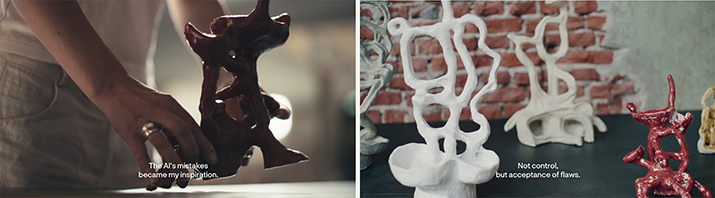
Figure 11. Movie Stills Text-to-Clay ‘Forming Uncertainty’:
Voice-over: “The AI’s mistakes became my inspiration”. “Not control, but acceptance of flaws.” (Burg van der et al., 2025)
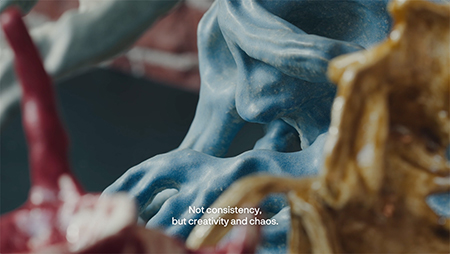
Figure 12. Movie Still Text-to-Clay ‘Caring for Instability’:
Voice-over: “Not consistency, but creativity and chaos.” (Burg van der et al., 2025)
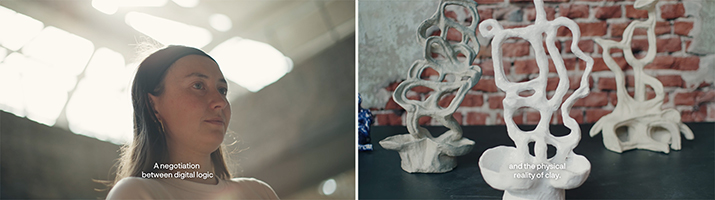
Figure 13. Movie Stills Text-to-Clay ‘Harmonizing Agencies’:
Voice-over: “A negotiation between digital logic and the physical reality of clay.” (Burg van der et al., 2025)
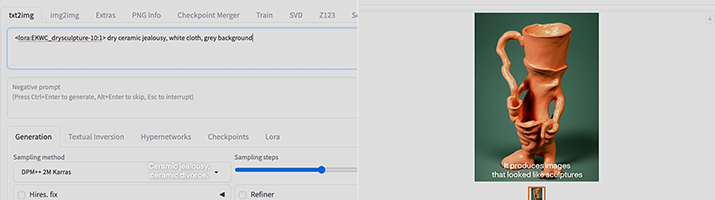
Figure 14. Movie Stills Text-to-Clay ‘Expressing Intentionalities’: Voice-over: “Ceramic jealousy, ceramic divorce.”
“It produces images that looked like sculptures, but filled with many impossibilities.” (Burg van der et al., 2025)
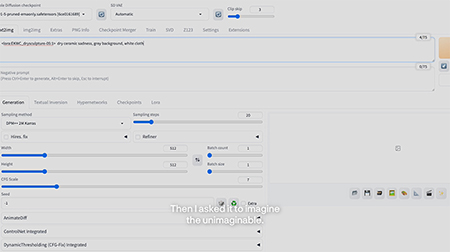
Figure 15. Movie Still Text-to-Clay ‘Anticipating Emergence’:
Voice-over: “And imagine the unimaginable.” (Burg van der et al., 2025)
Conclusion
This is the perspective I want to give to you: a concept of ‘aesthetics of intelligence’ that aims to move you from not seeing to seeing aesthetics in AI, and from seeing AI to seeing AI differently. The five formal qualities of intelligence: uncertainty, instability, agency, intentionality, and emergence are grounds where design can meet with science, technology, social science, philosophy, and the humanities. The five principles are offered to ‘disrupt your habits while also creating and suggesting new habits’ with a set of design vignettes that exemplify someone’s aesthetic compass, their values, and interest. The principles and exemplars aim to inspire you to develop your own aesthetic compass in line with your personal, human, and societal values, and to provide you with direction in these complex times.
Acknowledgments
I would like to thank the following: The IASDR organisation, especially Lin-Lin Chen, for inviting me as their keynote presenter to their conference in Taipei, Taiwan. ‘Designing with Intelligence’ research cluster at the TU/e, especially Jesse Benjamin, Lenneke Kuijer, Debargha Dey and Peng-Kai Hung. The ‘Artifice’ Educational Squad At ID, TU/e, especially Yaliang Chuang, Janet Huang, Mathias Funk, and all the students in the squad and the course Creativity & Aesthetics of Data & AI. Tuan-Ting Huang for the graphics and font design of the keynote presentation.
References
- ACE. (2023, March 5). TEDxAmsterdam Women and ACE introduce MissJourney. Retrieved https://ace.nl/en/featured/missjourney-an-ai-alternative-that-celebrates-women
- ACE. (n.d.). Missjourney.ai. Retrieved https://ace.nl/en/work/missjourney-ai
- Benjamin, J. J., Berger, A., Merrill, N., & Pierce, J. (2021). Machine learning uncertainty as a design material: A post-phenomenological inquiry. In Proceedings of the SIGCHI conference on human factors in computing systems (Article No. 171 ). ACM. https://doi.org/10.1145/3411764.3445481
- Bruns, M., Ossevoort, S., & Petersen, M. G. (2021). Expressivity in interaction: A framework for design. In Proceedings of the SIGCHI conference on human factors in computing systems (Article No. 163 ). ACM. https://doi.org/10.1145/3411764.3445231
- Burg van der, V., De Michele, M., Marković, J., Jurković, I., & Gustafsson, C. (2025). From-text-to-clay. 4TU Design United. https://www.4tu.nl/du/projects/From-Text-to-Clay/
- Chen, D. S., Cheng, L. L., Hummels, C. C. M., & Koskinen, I. (2016). Social design: An introduction. International Journal of Design, 10(1), 1-5. https://doi.org/10.57698/v10i1.01
- Dey, D., Matviienko, A., Berger, M., Pfleging, B., Martens, M., & Terken, J. (2021). Communicating the intention of an automated vehicle to pedestrians: The contributions of eHMI and vehicle behavior. it-Information Technology, 63(2), 123-141.
- Djajadiningrat, J. P., Overbeeke, C. J., & Wensveen, S. A. (2000). Augmenting fun and beauty: A pamphlet. In Proceedings of the conference on designing augmented reality environments (pp. 131-134). ACM.
- Djajadiningrat, T., Wensveen, S., Frens, J., & Overbeeke, K. (2004). Tangible products: Redressing the balance between appearance and action. Personal and Ubiquitous Computing, 8(5), 294-309.
- Dunne, A. (1997). Hertzian tales: An investigation into the critical and aesthetic potential of the electronic product as a post-optimal object [Unpublished doctoral dissertation]. Royal College of Art, United Kingdom.
- Hallnäs, L., & Redström, J. (2002). From use to presence: On the expressions and aesthetics of everyday computational things. ACM Transactions on Computer-Human Interaction, 9(2), 106-124. https://doi.org/10.1145/513665.513668
- Hauser, S., Redström, J., & Wiltse, H. (2023). The widening rift between aesthetics and ethics in the design of computational things. AI & Society, 38(1), 227-243.
- Koskinen, I. (2016). Agonistic, convivial, and conceptual aesthetics in new social design. Design Issues, 32(3), 18-29.
- Kuijer, L. (2024). Brys – Inspiration for more natural comfort. https://lennekekuijer.org/brys-en/
- Kuijer, L., & Laschke, M. (2024). Designing for a post-growth society through the eco-harmonist. A critical examination of the role of HCI and technology design. In Proceedings of the 13th Nordic conference on human-computer interaction (Article No. 69 ). ACM. https://doi.org/10.1145/3679318.368540
- Lenz, E., Hassenzahl, M., & Diefenbach, S. (2017). Aesthetic interaction as fit between interaction attributes and experiential qualities. New Ideas in Psychology, 47, 80-90.
- Lim, Y. K., Stolterman, E., Jung, H., & Donaldson, J. (2007, August). Interaction gestalt and the design of aesthetic interactions. In Proceedings of the conference on designing pleasurable products and interfaces (pp. 239-254). ACM. https://doi.org/10.1145/1314161.1314183
- Lomas, J. D., & Xue, H. (2022). Harmony in design: A synthesis of literature from classical philosophy, the sciences, economics, and design. She Ji: The Journal of Design, Economics, and Innovation, 8(1), 5-64. https://doi.org/10.1016/j.sheji.2022.01.001
- Markussen, T. (2013). The disruptive aesthetics of design activism: enacting design between art and politics. Design Issues, 29(1), 38-50.
- Noë, A. (2023). Toward an aesthetics for the entanglement. In The entanglement: How art and philosophy make us what we are (pp. 161-185). Princeton University Press.
- Oktay, G., Lee, M., Barati, B., and Wakkary, R. (2024). Caring through: Engaging with the temporality of care in more-than-human design. In Halfway to the Future (HTTF ’24). ACM. https://doi.org/10.1145/3686169.3686211
- Ross, P. R., & Wensveen, S. A. (2010). Designing aesthetics of behavior in interaction: Using aesthetic experience as a mechanism for design. International Journal of Design, 4(2), 3-13. https://doi.org/10.57698/v4i2.02
- Stjernholm, E., Eriksson, M., & Mohammadi Norén, F. (2025). On the historical gaze of Generative AI: Visions of Scandinavia in Stable Diffusion. Scandinavian Journal of History, 50(4), 458-488.
- Ter Hofstede, P. (Ed.). (1989). Memphis 1981-1988: Groninger Museum, 26.11. 1989-14.1. 1990. Groninger Museum.
- Terken, J., Levy, P., Wang, C., Karjanto, J., Yusof, N. M., Ros, F., & Zwaan, S. (2016). Gesture-based and haptic interfaces for connected and autonomous driving. In Proceedings of the AHFE international conference on human factors and system interactions (pp. 107-115). Springer International Publishing.
- Theelen, S., Talamini, G., Op het Veld, R., Sparidans, D., Benjamin, J., & Wensveen, S. (2026). Uncertainty in the studio: AI as a material in the design of tangible products [Manuscript submitted for publication]. Department of Industrial Design, Eindhoven University of Technology.
- Vitsoe. (n.d.). Ten principles for good design. Retrieved March 12, 2026, from https://www.vitsoe.com/gb/about/good-design
- Wensveen, S., Overbeeke, K., & Djajadiningrat, T. (2002). Push me, shove me and I show you how you feel: Recognising mood from emotionally rich interaction. In Proceedings of the 4th conference on designing interactive systems (pp. 335-340). ACM. https://doi.org/10.1145/778712.77875
