Longevity through Novelty: A Typology of Design Strategies for Strengthening Epistemic Value and Preventing Premature Replacement of Electronic Products
Hanchu Sun*, Giulia Granato, and Ruth Mugge
Faculty of Industrial Design Engineering, Delft University of Technology, Delft, the Netherlands
Many electronic products are replaced prematurely not because they fail functionally, but because consumers become satiated with features that once felt novel. In consumer research, this pattern is linked to a decline in epistemic value, defined as a product’s ability to provide novelty, stimulate curiosity, and introduce change of pace into routine use. This study investigates how design can strengthen the epistemic value of owned electronic products, thereby helping prevent premature replacement. Study 1 involved four design workshops (N = 24) that generated 298 design ideas, resulting in a typology of nine design strategies and 23 sub-strategies. The nine overarching strategies are hardware upgradability, expanded functionality via software, multi-purpose design, dynamic engagement, anthropomorphism, adaptability, novel static design, self-care, and timeless design. The first seven strategies actively aim to generate epistemic value, whereas self-care and timeless design primarily function to preserve the value. Study 2 refined the typology through semi-structured interviews with 11 industry professionals, providing practice-informed insights into the temporal implications of each strategy and the enabling conditions regarded as important in practice. Comparative analysis across the seven epistemic-value-generating strategies revealed three recurring principles: continuous evolvability, balanced user experience, and reinforcement of the product’s core value proposition.
Keywords – Consumer Electronics, Premature Obsolescence, Product Lifetime Extension, Product Longevity, Design Strategies.
Relevance to Design Practice – This research provides designers with a structured typology aimed at integrating epistemic value into electronic products. The identified strategies and sub-strategies, supported by practice-informed insights from industry professionals, offer actionable guidance for designing products that sustain novelty and curiosity over time, thereby helping to prevent premature replacement.
Citation: Sun, H., Granato, G., & Mugge, R. (2026). Longevity through novelty: A typology of design strategies for strengthening epistemic value and preventing premature replacement of electronic products. International Journal of Design, 20(2), 1-15. https://doi.org/10.57698/v20i2.01
Received November 12, 2025; Accepted June 16, 2026; Published August 31, 2026.
Copyright: © 2026 Sun, Granato, & Mugge. Copyright for this article is retained by the authors, with first publication rights granted to the International Journal of Design. All journal content is open-access and allowed to be shared and adapted in accordance with the Creative Commons Attribution 4.0 International (CC BY 4.0) License.
*Corresponding Author: h.sun-1@tudelft.nl
Hanchu Sun is a Ph.D. candidate at the Faculty of Industrial Design Engineering at Delft University of Technology (TU Delft), where he also obtained his MSc degree in Strategic Product Design. His Ph.D. research focuses on how design can help prevent the premature replacement of consumer electronic products. Specifically, he explores design interventions that strengthen epistemic value (the sense of novelty, curiosity, and change of pace) that consumers perceive in products they already own, thereby preventing boredom and satiation during ownership. Combining qualitative and experimental methods, his Ph.D. work bridges design research and consumer psychology. He has published in the Proceedings of the PLATE conference and the International Journal of Design.
Giulia Granato is an assistant professor at the Faculty of Industrial Design Engineering of TU Delft. Her research focuses on design for habit disruptions and sustainable behavioral change, at the intersection of environmental psychology, consumer behavior, and design. Contributing to these fields, she studies how design interventions can foster more sustainable behavioral change by disrupting established consumer routines and habitual patterns of consumption, across consumption domains including fashion (reducing consumption), electronics (tackling premature obsolescence), traveling (reducing air travel for short EU distance trips), and food-packaging (reducing animal origin consumption and favoring more sustainable packaging practices). Giulia publishes in a diverse range of scientific journals, from the Journal of Environmental Psychology, Economic Psychology, Resource Conservation and Recycling, Journal of Cleaner Production, and the International Journal of Design.
Ruth Mugge is Professor of Design for Sustainable Consumer Behavior at the Faculty of Industrial Design Engineering at TU Delft. Her main research interests are sustainable consumer behavior, product longevity, design for behavior change, and design for the circular economy. She has received both European and national (NWO) funding for her research, including a personal VICI grant on the value of design for slowing down premature obsolescence. She has published on these topics in various scientific journals, including the International Journal of Design, Design Studies, Journal of Product Innovation Management, and Resources, Conservation and Recycling, in which Ruth also serves as an associate editor.
Introduction
Current production and consumption patterns of electrical devices and electronic products surpass our planet’s sustainable capacity (Shittu et al., 2021). In 2022, 62 million tons of electrical and electronic devices were discarded, representing an 82% increase from 2010 (Baldé et al., 2024). Nearly half of this e-waste consists of everyday electronic products, including household appliances (such as vacuum cleaners and microwave ovens), small IT equipment (such as mobile phones and laptops), and screens (Baldé et al., 2024). Such e-waste raises serious environmental concerns, as approximately 80% of it is neither formally collected nor recycled after disposal, leading to the release of toxic materials and accelerating environmental degradation (World Health Organization, 2024).
Many electronic products are affected by premature replacement, in which consumers replace devices before they reach the end of their functional lifespan (Ylä-Mella et al., 2022). Empirical evidence demonstrated that, across diverse product categories, including household appliances such as washing machines and vacuum cleaners, the majority of products are replaced before they are fully broken. Specifically, 16% of washing machines, 21% of vacuum cleaners, and over 50% of televisions are replaced while still functioning well (Magnier & Mugge, 2022). A similar pattern is observed across 10 electronic product categories, from mobile phones to appliances such as ovens and refrigerators, in which nearly half of products are replaced while still functioning (Echegaray, 2016). In consumer replacement theory, the decision to replace a product prematurely is psychologically rooted in a value trade-off: consumers weigh the perceived value of their current product against the potential benefits and costs of a new model (Van den Berge et al., 2021). According to Sheth et al. (1991), consumer decision-making is consistently shaped by five distinct types of consumption values. These values include: (1) functional value (i.e., the product’s utilitarian and physical performance); (2) emotional value (i.e., the degree to which the product arouses feelings and emotional states); (3) epistemic value (i.e., the product’s ability to provide novelty, trigger curiosity, and meet the need for a change of pace); (4) social value (i.e., the degree to which the product fosters social associations); and (5) conditional value (i.e., the influence of specific circumstances/contexts on consumer preferences). Importantly, these values are interrelated rather than independent, meaning that a single design intervention may influence multiple values concomitantly (Van den Berge et al., 2021). To prevent premature replacement, research has highlighted the importance of strengthening the perceived value of currently owned products (Magnier & Mugge, 2022; Van den Berge et al., 2021). Existing literature has mainly concentrated on functional and emotional value, such as facilitating repair or product care behaviors (Ackermann et al., 2021; Van den Berge et al., 2023) or fostering emotional attachment through empathy, personal meaning, and narratives (Haines-Gadd et al., 2018; Orth et al., 2018).
Beyond functional and emotional values, recent research has highlighted the importance of epistemic value in consumers’ replacement decisions of electronic products (Hou et al., 2020; Magnier & Mugge, 2022). Consumers’ desire for stimulation and novelty determines how long they remain satisfied with owned products and how readily they are drawn to new-market offerings (Hirschman, 1980; Sevilla et al., 2019). New products initially offer high epistemic value, but as consumers are repeatedly exposed to the same product, familiarity increases, and the original sense of novelty diminishes, potentially leading to satiation and reduced engagement (Hou et al., 2020). Meanwhile, new-to-the-market products deliver renewed stimuli that encourage premature replacement (Cooper, 2016). To counter this trend, it is crucial to investigate which design strategies can strengthen epistemic value in owned devices.
Two research gaps emerge in the literature. First, prior studies emphasized epistemic value as a driver of new product purchases (e.g., Mugge & Dahl, 2013; Talke et al., 2017). This purchase-focused framing largely overlooks the importance of preserving the perceived value of owned products (Van den Berge et al., 2021; Van Nes, 2016). Second, there is no comprehensive overview of design strategies aimed at strengthening epistemic value in electronic products. To date, scholarly focus has concentrated on modularity (i.e., the ability to replace or upgrade modules), which can reduce the need for full-device replacement (Agrawal et al., 2016; Hielscher et al., 2020; Proske & Jaeger-Erben, 2019). However, broader opportunities may exist, especially with emerging technologies such as Artificial Intelligence (AI) and Internet of Things (IoT) in electronic products (Leong et al., 2024; To et al., 2016).
This paper addresses these gaps through two studies and makes two key contributions. First, Study 1 involved creative workshops to generate a wide range of design ideas, which were then systematically synthesized into a comprehensive typology of design strategies and sub-strategies intended to strengthen epistemic value during product ownership. Previous studies have developed typologies for other values, such as emotional value (Haines-Gadd et al., 2018) and functional value through product care (Ackermann et al., 2021), but a comparable investigation into epistemic value has been lacking. Second, Study 2 refines the design typology through semi-structured interviews with industry professionals, providing practice-based insights into the potential temporal implications of each strategy and the enabling conditions under which they may support longer product use, with the broader aim of reducing premature replacement.
Literature Review
The Decline of Epistemic Value after Purchase
The concept of epistemic value originates in Greek philosophy, where it was associated with the intrinsic human desire to acquire knowledge and understanding (Pritchard, 2009). In consumer research, this term has been reframed to encompass three key dimensions: novelty, curiosity, and change of pace (Sheth et al., 1991). First, novelty arises when individuals encounter new stimuli that do not match any stored representation in their memory (Barto et al., 2013). For example, consumers perceive a product’s form as novel when it deviates from established category norms (Mugge & Dahl, 2013). Second, curiosity refers to a psychological state triggered by a perceived knowledge gap between current understanding and what one seeks to learn through product interaction (Loewenstein, 1994). For example, consumers may experience curiosity when encountering unfamiliar features in a new product. Third, a change of pace reflects a desire for variety over time, which can be fulfilled through temporal variations that provide a refreshing break from routine (Sheth et al., 1991). This reflects the mechanism of habituation, whereby responsiveness to a repeated stimulus decreases over time but can be partially restored by introducing a different stimulus (Rankin et al., 2009).
A product’s epistemic value is typically high at the beginning of ownership, driven by novel aesthetics and functionalities. From a marketing perspective, these novel attributes are strategically leveraged to stimulate desire and thereby create a psychological “push” toward acquisition (Cooper, 2016; Van Nes & Cramer, 2005). However, the epistemic value of new products declines rapidly with repeated exposure. Longitudinal evidence on smartphone usage indicates that, compared to other values, epistemic value diminished most rapidly (Bødker et al., 2009). This decline aligns with hedonic adaptation theory, suggesting that repeated exposure to the same stimuli reduces their ability to evoke novelty and curiosity (Lyubomirsky, 2012). As consumers internalize a product’s features into stable mental models, their attention and cognitive engagement diminish, reducing the psychological benefits of continued use (Wang et al., 2009). Over time, this habituation process may give rise to boredom or satiation, heightening consumers’ sensitivity to new products that promise renewed epistemic value (Hou et al., 2020). From a sustainability perspective, novelty-driven strategies in new-to-the-market products have been criticized for accelerating premature replacement and e-waste (Cooper, 2020). In response, research has begun to recognize the potential of strengthening the epistemic value of owned electronic products as a promising pathway to prevent premature replacement (Agrawal et al., 2016; Khan et al., 2018; Van den Berge et al., 2021).
Strengthening Epistemic Value to Prevent Premature Replacement
Current research on strengthening epistemic value in owned electronic products primarily focused on modular design (Agrawal et al., 2016; Jaeger-Erben et al., 2023). Modularity enables repair and refurbishment by replacing worn or outdated modules while preserving most components and reducing the need for full-device replacement (Hielscher et al., 2020). Modular design principles have been adopted across various product categories, including smartphones, laptops, and headphones. While modularity offers clear advantages for sustainability, it also has limitations in reducing environmental impact. For example, a high degree of modularity (i.e., allowing replacement and upgrades of multiple parts) can lead to increased resource use and faster consumption of new components (Jaeger-Erben et al., 2023).
Furthermore, the environmental benefits of modular design depend heavily on consumer behavior. As consumers often prioritize convenience, they might choose to replace modular devices entirely rather than repair or upgrade modules (Hielscher et al., 2020). A primary focus on upgradability in modular design may therefore be insufficient to strengthen epistemic value or prevent premature replacement.
Beyond hardware-focused approaches, emerging digital technologies offer new opportunities for strengthening epistemic value in electronic products. For example, AI could personalize content, adapt system behaviors in real time, and produce context-aware variations that help maintain user interest over longer periods (Leong et al., 2024). Moreover, research in computer gaming has shown that epistemic value can be cultivated through gamification mechanisms, including narrative-driven exploration and challenges that balance uncertainty, complexity, and reward anticipation (Kim & Lee, 2017; To et al., 2016). Additionally, research on fast-moving consumer goods has explored strategies for preventing consumer satiation, such as lengthening intervals between consumption episodes and framing products as scarce (Galak et al., 2013; Sevilla & Redden, 2014). These examples suggest that broader design opportunities exist for strengthening epistemic value in electronic products. Yet a comprehensive investigation and classification of design strategies aimed at strengthening epistemic value in owned electronic products are still lacking. A systematic examination is needed to expand the design scope for “designing for epistemic value”, with the broader aim of preventing premature replacement.
Study 1
Method
To develop a typology of design strategies intended to strengthen epistemic value in electronic products during ownership, four design workshops were conducted. These sessions aimed to gather participants’ creative input and generate a wide range of ideas. The workshops took place in October and November 2024 at the Faculty of Industrial Design Engineering, Delft University of Technology, following approval by the university’s ethics committee. The workshops involved 24 participants (18 females; 5-7 per workshop); all were master’s students with bachelor’s degrees in product design. All data (written and sketch-based design ideas and audio recordings) were approved for analysis through consent forms. Participants received a 20-euro voucher.
Workshop’s Procedure
Each workshop lasted two hours and was divided into three parts: (1) a 10-minute introduction aimed at presenting the study’s objective and explaining the concept of epistemic value; (2) a 20-minute group mind-mapping exercise during which participants collaboratively generated associations based on three dimensions of epistemic value to familiarize themselves with the concept; and (3) a 90-minute brainstorming session. To facilitate broad exploration of product categories, the 90-minute brainstorming session was divided into three 30-minute rounds, each focusing on a distinct category of electronic products. This enabled us to explore a wide variety of design opportunities across interaction types, product sizes, and digital integration. Within each round, participants were tasked with generating design ideas for one or more products selected from three high-market-penetration options. The three categories included: (1) technology products, which incorporate advanced digital technologies (e.g., smartphones, laptops, TVs); (2) utilitarian products, designed for utility and efficiency (e.g., refrigerators, vacuum cleaners, washing machines); and (3) expressive products, which convey personal identity, symbolic meaning, or lifestyle (e.g., headphones, coffee machines). For expressive products, one option was left open for participants to select a product of their choice, accommodating the category’s subjective nature. To prevent sequencing biases, the category order varied across workshops. Each 30-minute session included: (1) a 20-minute individual brainstorming phase, during which participants were tasked to generate as many design ideas as possible using sticky notes or quick sketches; and (2) a 10-minute collaboration phase focused on building upon peers’ ideas and documenting any ideas that emerge. All audio recordings from the brainstorming sessions were transcribed, and both written and sketched ideas were documented in text. A coding procedure was applied to identify common design strategies and sub-strategies. The details of the coding procedure are available in Appendix A.
Results of Study 1
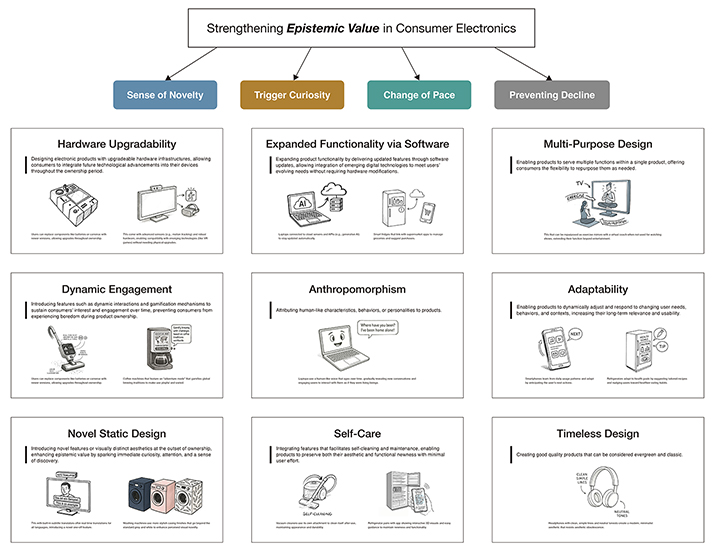
The thematic analysis yielded a typology comprising 9 design strategies and 23 sub-strategies, intended to strengthen the epistemic value of electronic products during the ownership phase. The nine strategies are:
- Hardware Upgradability, which enables users to access new product capabilities by incorporating hardware upgrades that accommodate future technological advancements.
- Expanded Functionality via Software, which expands a product’s capabilities by introducing new features, digital integrations, and performance enhancements through continuous software updates.
- Multi-Purpose Design, which integrates multiple functions into one device, enhancing versatility by enabling use for related or new purposes.
- Dynamic Engagement, which fosters ongoing user interest by incorporating interactive elements into products that encourage continuous exploration.
- Anthropomorphism, which introduces human-like attributes into product interactions that evolve and reveal new expressions over time, fostering curiosity and fascination.
- Adaptability, which enables products to continuously learn from users and adjust their functions, content, or behavior in response to evolving needs and preferences.
- Novel Static Design, which evokes immediate curiosity and surprise through distinctive product features or aesthetics.
- Self-Care, which aims to preserve a product’s functional condition and aesthetic quality through self-maintenance and guided upkeep.
- Timeless Design, which resists obsolescence through enduring quality and aesthetics.
The detailed sub-strategies for each strategy are presented in Table 1, each with a brief explanation and one design idea drawn from the workshop outcomes.
Table 1. Typology of nine design strategies and 23 sub-strategies intended to strengthen epistemic value in electronic products.
| Design Strategy | Sub-strategies | Explanation |
| Hardware Upgradability | Modular upgradability | Designing products with modular components that enable users to disassemble the product and replace parts with upgraded versions. |
| Built for future upgrades | Designing products with a pre-configured hardware architecture that supports future upgrades to incorporate technological advancements during product ownership. | |
| Expanded Functionality via Software | Cloud-based software updates | Delivering new features/improvements through cloud-based software updates, keeping devices consistently up to date. |
| IoT-driven synchronization | Expanding a product’s functionality by adding new features through data synchronization and integration with other IoT devices. | |
| Third-party app integration | Expanding a product’s functionality by enabling the product to integrate with third-party app services, combining device data with external services to provide novel features. | |
| Multi-Purpose Design | Extensions for core tasks | Integrate complementary features that extend the device’s primary function, enabling users to perform a variety of related tasks aligned with its core value proposition. |
| Repurpose for new roles | Reimagining the product with functions beyond its primary use to enable new purposes. | |
| Dynamic Engagement | Surprise and discovery | Introducing unexpected or gradually evolving interactions over time to foster ongoing user exploration and progressive discovery of new features/experiences. |
| Learning through use | Enriching user experience by fostering ongoing learning about the product’s features and capabilities. | |
| Reward-based gamification | Integrating gamified achievement/reward systems that adapt and progress according to how users interact with the product. | |
| Exploration-driven gamification | Designing gamified environments that frame product use as an ongoing journey of exploration, where evolving features provide users with new experiences over time. | |
| Limited-time features | Introduce time-limited digital features tied to seasons, events, or milestones to add novelty without altering core functions. | |
| Anthropomorphism | Friendly companion interactions | Anthropomorphizing products to interact with users in a personal and empathetic way, creating novelty through evolving conversations and unexpected expressions that sustain curiosity. |
| Evolving personality | Anthropomorphizing products that appear to grow and evolve over time in response to users’ engagement and care. | |
| Adaptability | Learning user behavior | Enabling products to analyze and learn user habits, preferences, and behaviors over time, allowing them to adapt to meet user’s evolving needs and expectations. |
| Nudging user behavior | Enabling products to adapt and effectively guide users toward desired goals by tracking and learning from their behavior. | |
| Adaptive self-expression | Enable users to express and evolve their identity by adapting the device’s interface and content over time to reflect their personal values and lifestyle. | |
| Novel Static Design | Novel feature | Introducing a one-time novel feature that delivers a sense of novelty without evolving or requiring future updates. |
| Novel appearance | Creating visual novelty in products by deliberately deviating from established visual norms within a product category. | |
| Self-Care | Self-cleaning system | Designing products that perform self-cleaning functions to maintain long-term functionality and aesthetic appeal. |
| Interactive maintenance guidance | Designing products that offer interactive, user-friendly maintenance guidance, ensuring upkeep remains simple and accessible over time. | |
| Timeless Design | Minimalist design | Prioritizing simplicity through minimalist design, characterized by clean lines and timeless color schemes that resist fleeting trends. |
| Age-gracefully design | Designing products with materials that evolve aesthetically over time, celebrating natural aging to create unique character and sustained aesthetic appeal with continued use. |
Discussion of Study 1
The thematic analysis yielded a typology of 9 design strategies and 23 sub-strategies, intended to strengthen the epistemic value of electronic products during the ownership phase (see Table 1). These strategies operate through two complementary temporal mechanisms. The first seven primarily aim to generate epistemic value through enabling hardware and software upgrades (Hardware Upgradability, Expanded Functionality via Software), integrating multiple functions (Multi-Purpose Design), fostering interactive and evolving experiences (Dynamic Engagement, Anthropomorphism, Adaptability), or introducing one-time novel elements (Novel Static Design). The remaining two primarily aim to preserve it by slowing its decline, through supporting self-maintenance (Self-Care) and avoiding trend-based obsolescence (Timeless Design). This distinction also helps clarify why some strategies may at first seem to be opposites. For example, Novel Static Design introduces striking novelty at the outset of ownership, whereas Timeless Design deliberately avoids trend-driven newness in favor of enduring aesthetic appeal. Rather than competing, the two represent complementary pathways for sustaining epistemic value over time.
The typology also suggests that strategies targeting epistemic value may simultaneously support other consumer values. Prior research indicates that value-strengthening strategies can stimulate multiple values concomitantly rather than targeting a single value in isolation (Sheth et al., 1991; Van den Berge et al., 2021). For example, Hardware Upgradability and Expanded Functionality via Software may enhance functional value by improving device capabilities over time. Multi-Purpose Design may support conditional value by enabling use across a wider range of situations. Anthropomorphism may foster emotional value by encouraging affective engagement and relational interaction with products. These overlaps illustrate that epistemic-value strategies do not necessarily operate in isolation but may reinforce other values that contribute to longer product use. In addition, several electronic products in the existing market illustrate how these strategies can be applied in practice. Representative market examples for each strategy are provided in Appendix B.
Although Study 1 was exploratory and design-oriented, its reliance on design students may have shaped the findings toward idea generation with limited consideration of practical implementation. While participants were trained to translate abstract concepts into concrete design ideas, they may not fully represent consumer-centered perspectives grounded in real usage needs, nor do they have direct experience developing electronic products in market contexts. These limitations raise two questions that the workshop data alone cannot address: whether these strategies can plausibly sustain epistemic value beyond initial ownership, and what conditions shape their long-term effectiveness. Study 2 explores these questions through interviews with industry professionals experienced in B2C electronic products.
Study 2
Method
Study 2 was conducted to expand and refine the design typology identified in Study 1 through semi-structured expert interviews. The study focused on the nine overarching strategies rather than all 23 sub-strategies, as these represent higher-order design concepts that provide generalizable insights while allowing discussion within the 75-minute interview format.
The ethical committee of Delft University of Technology approved Study 2. Eleven professionals participated (see Appendix C), drawn from design agencies and companies working on B2C electronic products. All had direct experience in the design and product development of B2C electronic products, including both consumer electronics and household appliances. This sample was selected because such professionals build a repertoire of tacit, pattern-based expertise through sustained engagement with user research, consumer feedback, and product evaluation (Cross, 2004; Schön, 1983), enabling them to anticipate potential user responses to product features and interactions. The interviews aimed to: (1) assess the clarity and completeness of the typology; (2) discuss the potential temporal implications of each strategy for sustaining epistemic value during ownership; and (3) identify possible enabling conditions that industry professionals regard as important for supporting each strategy’s long-term effectiveness.
Each session began with a brief explanation of epistemic value. Participants were then shown an A0 poster (see Appendix D) presenting the nine design strategies, each accompanied by a short description and illustrative examples, to ensure a shared understanding and a common reference throughout the interview. Participants reviewed each strategy and responded to two questions: (1) whether the strategy was understandable, and (2) how they perceived its potential temporal effect on sustaining epistemic value (short-term, long-term, or uncertain), and why. After reviewing all nine strategies, participants were asked to propose additional strategies if they considered the typology incomplete. All interviews were audio-recorded and transcribed with informed consent. A codebook was created, and the second and third author cross-checked the analysis.
Results and Discussion of Study 2
Overall, experts demonstrated a clear understanding of all nine design strategies and their illustrative examples. As no fundamentally new strategies were proposed, the typology appeared comprehensive in its coverage of design approaches aimed at strengthening epistemic value. In terms of temporal implications, some design strategies received stronger agreement than others. Full agreement was reached on three strategies1: Self-Care and Timeless Design were universally considered long-term, while Novel Static Design was seen as short-term due to its trend-based nature. Three other strategies were regarded as long-term by the majority of experts: Expanded Functionality via Software (9 long-term; 2 uncertain), Hardware Upgradability (7 long-term; 4 short-term), and Adaptability (7 long-term; 3 short-term). The remaining three strategies elicited more varied opinions: Multi-Purpose Design (5 long-term; 3 uncertain; 3 short-term), Dynamic Engagement (5 long-term; 1 uncertain; 5 short-term), and Anthropomorphism (3 long-term; 3 uncertain; 5 short-term).
As experts explained their evaluations, they identified key design and implementation considerations for sustaining epistemic value over time, which this study refers to as enabling conditions. Short-term or uncertain evaluations were particularly informative, as they revealed barriers (e.g., technical constraints or the risk of user disengagement) that need to be addressed for a strategy to sustain epistemic value over time. For strategies evaluated as having long-term potential, experts also specified conditions that could further extend their impact, such as integrating emerging technologies. Table 2 summarizes the enabling conditions for each strategy. Comparative analysis of these strategy-level findings revealed recurring patterns across strategies that actively aim to generate epistemic value during ownership, converging into three broader principles. The following sections first present the strategy-level analyses and then synthesize the recurring patterns.
Table 2. Expert-identified enabling conditions for applying the nine design strategies in practice.
| Design strategy | Enabling conditions for sustaining epistemic value over time |
| Hardware Upgradability |
|
| Expanded Functionality via Software |
|
| Multi-Purpose Design | |
| Dynamic Engagement | |
| Anthropomorphism | |
| Adaptability | |
| Novel Static Design | |
| Self-Care | |
| Timeless Design |
Hardware Upgradability
Hardware Upgradability was perceived as contingent on the product’s physical and architectural flexibility. As Participant 8 noted: “With larger consumer electronics, retrofitting (hardware) might be more feasible simply due to the scale of the product. For smartphones, retrofitting can be extremely complicated.” This aligns with prior research suggesting that retrofit potential depends on whether the design supports the physical, functional, and architectural conditions required for upgradability (Khan et al., 2018). In smartphones, increasingly integrated architectures improve compactness but limit access to core components (Jaeger-Erben et al., 2023).
Beyond feasibility, experts stressed that success depends on managing expectations over time. As Participant 9 suggested, “Disappointment is very crucial here. That future promise of upgradability could lead to disappointment later on if what is actually offered is not what customers were hoping for.”
Finally, experts highlighted that large-scale realization depends on industry-wide standardization and interoperability. As Participant 7 noted, “There are many cases where users think, ‘I want to use this great new attachment for my device.’ If interoperability is improved through standardization, people can keep using their main device longer and still enjoy the new functionality.” Without standardized and compatible interfaces that enable components and upgrades to function across systems, upgrade pathways remain fragmented and difficult to scale (Hielscher et al., 2020; Khan et al., 2018).
Expanded Functionality via Software
Experts noted that this strategy delivers ongoing novelty with cumulative long-term effects. As Participant 8 stated, “I think with software, the nature of the changes you can deliver means they’ll often feel short-term in the moment, but if you keep introducing them, they collectively have a long-term effect.”
First, this strategy is especially effective for digital products and connectivity-enabled devices where digital augmentation is integral to the user experience. Second, experts emphasized that software updates must reinforce the product’s core value and usability without disrupting existing routines, as effective upgrades should enhance performance without eroding familiarity or skills accumulated through prior use (Wang et al., 2018). Third, the pacing of updates also requires careful balance: frequent enough to sustain interest but not so often as to induce fatigue. Last, experts highlighted interoperability as key. As Participant 4 noted: “I think interoperability is crucial here. If the company became obsolete, the whole product would become obsolete. Devices should not become obsolete purely because of the software they operate with, they should be upgradeable with software not tied to the same proprietary source.” This concern aligns with research on upgradable product-service systems, which warns that dependence on proprietary ecosystems can lock consumers into restrictive contracts, undermining both sustainability and user autonomy (Pialot et al., 2017).
Multi-Purpose Design
Multi-Purpose Design was considered effective only when grounded in a clearly defined core value proposition. As Participant 8 noted: “If Multi-Purpose Design is too vague or scattered, people probably won’t see the value. I would say Multi-Purpose Design could support long-term engagement, as long as it is clear what the core value proposition of the product is.” This is consistent with prior research showing that multifunctionality creates value only up to a moderate level, after which complexity and perceived risk increase (Rijsdijk & Hultink, 2009). This trade-off is compounded when added functions are heterogeneous, as consumers tend to outweigh capability relative to usability before purchase, but experience feature fatigue when dissimilar functions prove harder to integrate into coherent use (Fürst et al., 2024; Thompson et al., 2005).
Beyond coherence, experts emphasized that added functions must be meaningfully embedded within users’ everyday routines. As Participant 2 explained, “What’s important is designing the product and its environment so that these functions are consistently usable and meaningful. The purposes packaged into one product should follow some clear, linear connection.”
Finally, experts stressed that Multi-Purpose Design should unfold over time rather than be presented simultaneously. As Participant 10 warned, “If all those features are introduced at the start, it is just like any other product. It doesn’t really add novelty over time.” This aligns with prior findings that early attraction to multifunctionality may turn into disappointment when added features increase complexity and undermine usability (Page, 2009). Instead, introducing functions gradually may help sustain curiosity because interruptions in an experience can disrupt adaptation and partially restore enjoyment rather than allowing novelty to be exhausted all at once (Nelson et al., 2009).
Dynamic Engagement
Dynamic Engagement was seen as promising but fragile, as repeated stimulation can quickly lose its impact through habituation (Rankin et al., 2009). As P4 noted, “People often get used to interface elements or adaptive feedback, which can lose novelty relatively quickly.”
To counter this, experts suggested that dynamic features should balance stimulation beyond simplicity without overwhelming users: “There’s also the risk of overdoing it. Sometimes, the promise of the product is its simplicity and functionality. So, if you push it too far, it could backfire” (P5).
Experts further suggested that dynamic elements should evolve gradually through staged discovery. As P8 observed, “It’s hard to get right, but if you do, it can have long-term impacts. It has to evolve to keep attention constantly.” In gamified contexts, this benefits from coherent narrative: “You need to keep challenging users. So, the feedback loop needs to be well-designed and structured with a sense of narrative progression to keep users engaged” (P11). This temporal logic is consistent with prior research showing that interruptions and segmentation can partially renew enjoyment, even in experiences often assumed to be best when continuous (Nelson et al., 2009). Related consumer research similarly suggests that slower pacing and longer intervals between episodes can reduce satiation over time (Galak et al., 2013).
Finally, experts suggested that Dynamic Engagement may help prevent habituation when it fosters user learning or skill acquisition: “To create an interaction that is long-lasting, it also needs to be gratifying so people won’t get bored. People are often interested in interactions that allow them to gain skills or knowledge over time” (P4).
Anthropomorphism
Experts noted that anthropomorphic cues risk losing their impact when interactions become repetitive: “If you hear the same prompt three days in a row, by the third day, you are probably already bored with it” (P3). Instead, anthropomorphic expressions should evolve over time to sustain curiosity.
A second boundary condition concerns excessive human-likeness. As Participant 2 noted, “It’s about building a sense of friendliness, so it doesn’t feel intrusive or aggressive. Otherwise, users might get irritated.” This concern aligns with uncanny valley theory, which suggests that as systems become more human-like, they evoke stronger expectations that, when violated, create a perceptual mismatch leading to eeriness and perceived threat (Mende et al., 2019).
Beyond these constraints, experts identified generative AI as a key opportunity. As Participant 11 observed, “With these new generative AI voice assistants, you can customize the tone to be friendly, serious, or even a bit eccentric. That felt genuinely novel to me.” Recent work suggests that generative AI can extend anthropomorphic design beyond static human-like cues by enabling adaptive, context-sensitive interactions through perceptual, linguistic, and behavioral modulation (Xiao et al., 2025). Yet this promise was tempered by caution. As Participant 10 warned, “The problem is that AI talks as if it has a self, starting sentences with ‘I.’ This can sometimes feel creepy to people. A better approach is to design systems with playful and engaging personalities without directly imitating humans.”
Adaptability
Experts suggested two barriers that may constrain Adaptability’s potential to strengthen epistemic value. The first barrier concerns the risk that adaptive features become overly automated and fade into the background once user behaviors stabilize. As Participant 4 explained, “That might spark novelty at first, but in my experience, users tend to lose interest in these kinds of suggestions quickly. They become background noise.” To address this, experts emphasized that adaptive systems should introduce ongoing variation and fresh content to prevent stagnation, a principle shared with Dynamic Engagement and Anthropomorphism.
The second barrier concerns the risk that continuous personalization reinforces habitual routines and thus discourages exploration: “If a system learns your behavior and adapts to it, it may encourage you to keep doing the same things because it’s optimized for them. That can reduce the need to learn something new or explore unfamiliar features” (P2). This concern aligns with research showing that fully adaptive systems work well for routine tasks but can reduce users’ involvement, leaving them less prepared for unfamiliar situations (Lavie & Meyer, 2010). Similarly, recommendation systems trained on past behavior can create feedback loops that homogenize behavior without improving utility, reinforcing rather than broadening user habits (Chaney et al., 2018). To mitigate this, experts highlighted that users should retain control over automation. As Participant 7 noted, “Because maybe you don’t like the habit, and then the product is making it even worse for you. So, being in control is really important.”
Novel Static Design
Novel Static Design was regarded by all experts as short-term, primarily due to its reliance on short-lived trends. However, two enabling conditions may enhance its effectiveness. First, when novel static elements facilitate personalization, they may transcend trend-driven obsolescence. As Participant 4 observed, “If it’s based on trends, it’s probably short-term. However, if it allows for real personalization or is deeply aligned with the user’s identity, it could be longer-lasting.” This aligns with previous research showing that personalization strengthens emotional bonding by enabling self-expression and by increasing the sense of ownership and control users feel toward their products (Mugge et al., 2009). Second, static designs may sustain epistemic value when associated with exclusivity: “If I buy something that gives me a sense of exclusivity, like I’m one of the few to access this new feature, it can feel very novel… especially if the brand remains the only one offering the feature even two years later” (P6). Similar effects have been observed in the FMCG domain, where scarcity helps slow satiation and sustain enjoyment across repeated use (Sevilla & Redden, 2014).
Self-Care
While experts agreed on the strategy’s long-term potential to preserve a product’s functional condition and aesthetic quality, experts highlighted the value of embedding Dynamic Engagement mechanisms (e.g., feedback loops or gamified elements) into maintenance routines. As Participant 4 noted: “By designing interactions that make care routines more tangible or rewarding, especially if users receive feedback or acknowledgment for completing maintenance tasks, it can foster a sense of completion and even pride in taking care of the product.” This resonates with prior research on product care design strategies, which identified “experience of the product care activity” as an approach that makes maintenance pleasurable through gamification (Ackermann et al., 2021). In addition, experts noted that Self-Care is particularly relevant for electronic appliances subject to visible wear (e.g., vacuum cleaners, ovens), where upkeep directly affects perceived newness. This aligns with research showing that extending product lifetime requires simplifying maintenance routines, reducing dirt accumulation, and preserving a visually “clean” appearance (Harmer et al., 2019).
Timeless Design
Timeless Design was consistently regarded as having strong long-term potential to prevent declines in epistemic value. However, experts identified barriers that may constrain broader adoption. One key concern is that products embodying Timeless Design often remain niche offerings associated with premium pricing. As Participant 3 noted: “A timeless design adds value. Also, I’d like to mention pricing. That’s related to their higher price and the quality people expect. This premium positioning could also restrict its accessibility to a wider consumer base.” This concern aligns with empirical evidence indicating that timeless appeals primarily attract higher-income consumers, as their emphasis on “quality over quantity” is often perceived as less attainable among lower socioeconomic groups (Chen & Liu, 2023). A second barrier concerns limited salience at the point of purchase. As Participant 4 explained: “The challenge is at the point of purchase. When people are bombarded with options and messages about new features or trends, it is difficult for them to recognize and appreciate the value of timelessness.” These insights suggest that for Timeless Design to become more viable at scale, its long-term value must be communicated more clearly to consumers.
Cross-Strategy Patterns in Enabling Conditions
Comparative analysis reveals three recurring principles that emerged most clearly across the seven generating-epistemic value strategies. By contrast, these principles were less salient for Self-Care and Timeless Design, which aim to preserve rather than actively renew epistemic value.
First, continuous evolvability captures the idea that novelty must be continually renewed rather than remain static. This principle is reflected in Hardware Upgradability as the need for upgrade pathways to be reliably fulfilled and sustained over time; in Expanded Functionality via Software as the recognition that cumulative, ongoing updates rather than any single release maintain novelty; in Multi-Purpose Design as the recommendation to introduce functions gradually to extend discovery; and in Dynamic Engagement, Anthropomorphism, and Adaptability alike as the shared warning that initially engaging features rapidly habituate users and must therefore evolve. The absence of this temporal dimension is precisely why Novel Static Design was considered short-term.
Second, balanced user experience concerns the appropriate calibration of pacing, stimulation, and complexity. This principle is reflected in Expanded Functionality via Software and Multi-Purpose Design as the shared concern that excessive update frequency or feature accumulation induces fatigue and increases perceived complexity; in Dynamic Engagement and Anthropomorphism as the parallel caution that overstimulation, whether through interaction intensity or excessive human-likeness, risks overwhelming or irritating users rather than sustaining engagement; and in Adaptability as the concern that over-automation causes adaptive features to fade into background noise, losing their capacity to engage users once initial novelty subsides.
Third, reinforcing the core value proposition serves as a coherence principle that guides how novelty must be meaningfully integrated into the product experience. This principle is reflected in Expanded Functionality via Software and Multi-Purpose Design as the shared condition that features and functions must remain anchored in a clearly defined primary purpose rather than diluting core usability; in Dynamic Engagement and Anthropomorphism as the parallel concern that novelty risks appearing gimmicky when disconnected from the product’s primary function; in Adaptability as the emphasis that personalization should remain meaningfully responsive to users’ evolving needs rather than reinforcing existing behavioral patterns; and in Novel Static Design as the suggestion that static novelty gains more lasting value when tied to meaningful personalization rather than surface-level trend change.
General Discussion
Theoretical Implications
Although prior research has highlighted the potential of strengthening epistemic value to prevent the premature replacement of electronic products (e.g., Van den Berge et al., 2021), how this value can be supported through design has remained largely unexplored. This study addresses this gap by identifying a comprehensive design typology consisting of nine overarching strategies and 23 sub-strategies intended to strengthen epistemic value during product ownership. It further extends this typology by incorporating practice-informed insights from industry professionals regarding temporal implications and enabling conditions.
Our design typology connects to prior value-strengthening frameworks, particularly those targeting emotional value. Because consumer values are interrelated, a single design intervention can reinforce multiple values concomitantly (Van den Berge et al., 2021). Several strategies in our epistemic-value typology overlap with themes in the Emotional Durability Design Nine (Haines-Gadd et al., 2018). For example, Anthropomorphism corresponds to consciousness- and conversation-oriented themes (e.g., animacy, character, responsive cues), while Dynamic Engagement reflects imagination-oriented strategies (e.g., surprise, anticipation).
However, these overlaps do not weaken the need for a distinct epistemic-value framework. Emotional value explains product retention through attachment and meaning (e.g., relationships, narratives) (Haines-Gadd et al., 2018), whereas our typology addresses a different pathway: the habituation-driven decline of novelty and curiosity, which is particularly salient in electronic products due to technological change and repeated digital interactions. Anthropomorphism illustrates this distinction: in emotional frameworks it strengthens product attachment through relational bonding, whereas in the epistemic value perspective it sustains curiosity through evolving, unpredictable expressions. Theoretically, psychological durability can thus not be reduced to emotional durability alone and includes other routes (Haug, 2019), among which epistemic value represents a distinct pathway. Empirically, epistemic value has been identified as a key driver of premature replacement in electronic products (Bødker et al., 2009; Magnier & Mugge, 2022), underscoring the need for targeted design strategies. Our study addresses this gap by offering a targeted design typology to sustain epistemic value, positioning it as complementary to existing approaches to preventing premature replacement.
Our paper also contributes to the field of sustainable design, which has so far emphasized modular upgradability as the primary approach for renewing epistemic value (e.g., Agrawal et al., 2016; Hielscher et al., 2020). This focus has overlooked the potential of interactive features and emerging digital technologies that are increasingly integrated into electronic products. To broaden this scope, our typology identifies a diverse range of strategies intended to strengthen epistemic value, spanning hardware and software upgrades, multi-functionality, dynamic and adaptive interactions, emphasis on novel elements, and preservation of functional performance and aesthetic newness.
Our findings also extend earlier studies on product longevity, which often proposed generalized “Design for...” principles. Those most relevant to epistemic value include design for upgradeability (Den Hollander et al., 2017; Mugge et al., 2005; Van Nes & Cramer, 2005), adaptability (Bocken et al., 2016), and variability (Van Nes & Cramer, 2005). While these principles provided foundational guidance, they were typically articulated at an abstract level without specifying how they could be operationalized in design practice. Our study advances this body of knowledge by translating these broad principles into concrete design strategies and sub-strategies tailored to electronic products.
Furthermore, our paper builds on prior typology-building design research (Ackermann et al., 2021; Haines-Gadd et al., 2018) by extending this approach to epistemic value. Study 2 advances this further by incorporating practice-informed insights on the temporal implications of the strategies and the enabling conditions under which they may support longer product use, dimensions not addressed in these earlier typologies. Across the interviews, the industry professionals generally viewed strategies that enable functional or interactive evolution as more promising for strengthening epistemic value over time than strategies relying primarily on static or trend-driven novelty. Upgradability-oriented strategies were more often interpreted as offering a relatively stable pathway for renewing novelty during ownership. By contrast, interaction-intensive strategies (e.g., Dynamic Engagement and Anthropomorphism) were seen as more context-dependent, with their potential shaped by execution quality, pacing, and user context. As these findings reflect practice-informed insights rather than empirical evidence of long-term user behavior, the nine strategies are best interpreted as conditional pathways whose long-term effectiveness depends on the enabling conditions identified in this study. Comparative analysis further suggests that, among the strategies that actively aim to generate epistemic value, three recurring cross-strategy principles emerged: continuous evolvability, balanced user experience, and reinforcement of the core value proposition.
Practical Implications
In addition to its theoretical contributions, this study offers practical guidance for design practitioners. The typology derived from Study 1 and the enabling conditions identified in Study 2 can serve as a checklist and a brainstorming resource for integrating epistemic value into the design of electronic products that support product longevity. Designers may apply individual strategies or combine several of them in electronic devices to further strengthen epistemic value. Moreover, design practice must balance cost, complexity, and trade-offs, especially concerning environmental impact. Strategies to strengthen epistemic value should be evaluated for their ecological footprint to ensure that the environmental benefits of extended product use outweigh the additional material and energy costs. For example, Hardware Upgradability adds components but can still reduce overall resource use if only specific modules (e.g., the camera) are replaced while retaining core parts such as the PCB.
Limitations and Avenues for Future Research
Several limitations should be highlighted. First, this study is exploratory in scope, and neither study directly captures consumer perspectives. In Study 1, the design strategies were generated through workshops with student designers, meaning the resulting typology primarily reflects design-oriented ideation rather than actual consumer needs or usage experiences. In Study 2, the typology was refined through expert interviews with industry professionals. Even though these experts are trained to anticipate user responses, it remains important to validate the strategies’ effects with actual users. Future research should therefore test selected strategies with consumers in actual usage contexts to assess their effects on epistemic value and their potential to reduce premature replacement. Second, the typology does not specify which strategies, individually or in combination, are most effective across different product categories and consumer segments. Future research could explore how variations across product types affect the effectiveness of design strategies. Third, presenting the nine strategies on a structured A0 poster may have introduced a framing effect, leading experts to evaluate the predefined categories rather than propose fundamentally new ones. Future studies could adopt more open-ended formats to explore alternative strategies beyond this typology.
Conclusion
To help prevent the premature replacement of electronic products and thereby reduce e-waste, designers could focus on strengthening products’ epistemic value‒their ability to offer novelty, curiosity, and a change of pace throughout ownership. This can be approached through strategies such as expanding functionality via hardware or software upgrades, incorporating dynamic interactions that sustain engagement, or preserving a sense of newness over time. To support long-term impact, these strategies should continuously evolve rather than remain static, while maintaining a balanced user experience and coherence with the product’s core value proposition. Understanding the spectrum of possible design approaches and the conditions under which they may support continued use can offer valuable insights for designers and design researchers seeking to extend product lifetimes from an epistemic value perspective.
Acknowledgment
This publication is part of the research project “Slowing down premature obsolescence: Keeping the value of consumer electronics high by design” (file number VI.C.221.020), funded by the Dutch Research Council (NWO) through the NWO VICI program. We would also like to thank all participants in Studies 1 and 2 for their contributions.
Endnote
- 1. Participant 9 attended only the first half of the joint session, resulting in missing responses for four design strategies: Adaptability, Novel Static Design, Self-Care, and Timeless Design.
References
- Ackermann, L., Tuimaka, M., Pohlmeyer, A. E., & Mugge, R. (2021). Design for product care–Development of design strategies and a toolkit for sustainable consumer behaviour. Journal of Sustainability Research, 3(2), Article e210013. https://doi.org/10.20900/jsr20210013
- Agrawal, V. V., Atasu, A., & Ülkü, S. (2016). Modular upgradability in consumer electronics: Economic and environmental implications. Journal of Industrial Ecology, 20(5), 1018-1024. https://doi.org/10.1111/jiec.12360
- Baldé, C. P., Kuehr, R., Yamamoto, T., McDonald, R., D’Angelo, E., Althaf, S., Bel, G., Deubzer, O., Fernandez-Cubillo, E., Forti, V., Gray, V., Herat, S., Honda, S., Iattoni, G., Khetriwal, D. S., di Cortemiglia, V. L., Lobuntsova, Y., Nnorom, I., Pralat, N., & Wagner, M. (2024). The global e-waste monitor 2024. Retrieved from https://ewastemonitor.info/the-global-e-waste-monitor-2024/
- Barto, A., Mirolli, M., & Baldassarre, G. (2013). Novelty or surprise? Frontiers in Psychology, 4, Article 907. https://doi.org/10.3389/fpsyg.2013.00907
- Bocken, N. M. P., de Pauw, I., Bakker, C., & van der Grinten, B. (2016). Product design and business model strategies for a circular economy. Journal of Industrial and Production Engineering, 33(5), 308-320. https://doi.org/10.1080/21681015.2016.1172124
- Bødker, M., Gimpel, G., & Hedman, J. (2009). The user experience of smart phones: A consumption values approach. Retrieved July 27, 2026, from https://www.researchgate.net/publication/245586941_The_User_Experience_of_Smart_Phones_A_Consumption_Values_Approach
- Braun, V., & Clarke, V. (2006). Using thematic analysis in psychology. Qualitative Research in Psychology, 3(2), 77-101. https://doi.org/10.1191/1478088706qp063oa
- Chaney, A. J. B., Stewart, B. M., & Engelhardt, B. E. (2018). How algorithmic confounding in recommendation systems increases homogeneity and decreases utility. In Proceedings of the 12th conference on recommender systems (pp. 224-232). ACM. https://doi.org/10.1145/3240323.3240370
- Chen, W. F., & Liu, J. (2023). When less is more: Understanding consumers’ responses to minimalist appeals. Psychology & Marketing, 40(10), 2151-2162. https://doi.org/10.1002/mar.21869
- Cooper, T. (2016). The significance of product longevity. In T. Cooper (Ed.), Longer lasting products: Alternatives to the throwaway society (pp. 3-36). Routledge.
- Cooper, T. (2020). Slower cycles: An essential characteristic of the circular economy. In S. Eisenriegler (Ed.), The circular economy in the European Union: An interim review (pp. 99-116). Springer. https://doi.org/10.1007/978-3-030-50239-3_9
- Cross, N. (2004). Expertise in design: An overview. Design Studies, 25(5), 427-441. https://doi.org/10.1016/j.destud.2004.06.002
- Den Hollander, M. C., Bakker, C. A., & Hultink, E. J. (2017). Product design in a circular economy: Development of a typology of key concepts and terms. Journal of Industrial Ecology, 21(3), 517-525. https://doi.org/10.1111/jiec.12610
- Echegaray, F. (2016). Consumers’ reactions to product obsolescence in emerging markets: The case of Brazil. Journal of Cleaner Production, 134(A), 191-203. https://doi.org/10.1016/j.jclepro.2015.08.119
- Fürst, A., Pecornik, N., & Hoyer, W. D. (2024). How product complexity affects consumer adoption of new products: The role of feature heterogeneity and interrelatedness. Journal of the Academy of Marketing Science, 52(2), 329-348. https://doi.org/10.1007/s11747-023-00933-7
- Galak, J., Kruger, J., & Loewenstein, G. (2013). Slow down! Insensitivity to rate of consumption leads to avoidable satiation. Journal of Consumer Research, 39(5), 993-1009. https://doi.org/10.1086/666597
- Haines-Gadd, M., Chapman, J., Lloyd, P., Mason, J., & Aliakseyeu, D. (2018). Emotional durability design nine–A tool for product longevity. Sustainability, 10(6), Article 1948. https://doi.org/10.3390/su10061948
- Harmer, L., Cooper, T., Fisher, T., Salvia, G., & Barr, C. (2019). Design, dirt and disposal: Influences on the maintenance of vacuum cleaners. Journal of Cleaner Production, 228, 1176-1186. https://doi.org/10.1016/j.jclepro.2019.04.101
- Haug, A. (2019). Psychologically durable design: Definitions and approaches. The Design Journal, 22(2), 143-167. https://doi.org/10.1080/14606925.2019.1569316
- Hielscher, S., Jaeger-Erben, M., & Poppe, E. (2020). Modular smartphones and circular design strategies: The shape of things to come? In T. Tudor & C. J. Dutra (Eds.), The Routledge handbook of waste, resources and the circular economy (pp. 337-349). Routledge.
- Hirschman, E. C. (1980). Innovativeness, novelty seeking, and consumer creativity. Journal of Consumer Research, 7(3), 283-295. https://doi.org/10.1086/208816
- Hou, C., Jo, M.-S., & Sarigöllü, E. (2020). Feelings of satiation as a mediator between a product’s perceived value and replacement intentions. Journal of Cleaner Production, 258, Article 120637. https://doi.org/10.1016/j.jclepro.2020.120637
- Jaeger-Erben, M., Proske, M., & Hielscher, S. (2023). Scalability and durability, or: Is modular the new durable? The case of smartphones. In M. Jaeger-Erben, H. Wieser, M. Marwede, & F. Hofmann (Eds.), Durable economies: Organizing the material foundations of society (pp. 201-230). Transcript Verlag. https://doi.org/10.1515/9783839463963-009
- Khan, M. A., Mittal, S., West, S., & Wuest, T. (2018). Review on upgradability–A product lifetime extension strategy in the context of product service systems. Journal of Cleaner Production, 204, 1154-1168. https://doi.org/10.1016/j.jclepro.2018.08.329
- Kim, Y.-B., & Lee, S.-H. (2017). Mobile gamer’s epistemic curiosity affecting continuous play intention. Focused on players’ switching costs and epistemic curiosity. Computers in Human Behavior, 77, 32-46. https://doi.org/10.1016/j.chb.2017.08.023
- Lavie, T., & Meyer, J. (2010). Benefits and costs of adaptive user interfaces. International Journal of Human-Computer Studies, 68(8), 508-524. https://doi.org/10.1016/j.ijhcs.2010.01.004
- Leong, J., Pataranutaporn, P., Danry, V., Perteneder, F., Mao, Y., & Maes, P. (2024). Putting things into context: Generative AI-enabled context personalization for vocabulary learning improves learning motivation. In Proceedings of the SIGCHI conference on human factors in computing systems (Article No. 667). ACM. https://doi.org/10.1145/3613904.3642393
- Loewenstein, G. (1994). The psychology of curiosity: A review and reinterpretation. Psychological Bulletin, 116(1), 75-98. https://doi.org/10.1037/0033-2909.116.1.75
- Lyubomirsky, S. (2012). Hedonic adaptation to positive and negative experiences. In S. Folkman (Ed.), The Oxford handbook of stress, health, and coping (pp. 200-224). Oxford University Press. https://doi.org/10.1093/oxfordhb/9780195375343.013.0011
- Magnier, L., & Mugge, R. (2022). Replaced too soon? An exploration of western european consumers’ replacement of electronic products. Resources, Conservation and Recycling, 185, Article 106448. https://doi.org/10.1016/j.resconrec.2022.106448
- Mende, M., Scott, M. L., Van Doorn, J., Grewal, D., & Shanks, I. (2019). Service robots rising: How humanoid robots influence service experiences and elicit compensatory consumer responses. Journal of Marketing Research, 56(4), 535-556. https://doi.org/10.1177/0022243718822827
- Mugge, R., & Dahl, D. W. (2013). Seeking the ideal level of design newness: Consumer response to radical and incremental product design. Journal of Product Innovation Management, 30(S1), 34-47. https://doi.org/10.1111/jpim.12062
- Mugge, R., Schoormans, J. P. L., & Schifferstein, H. N. J. (2005). Design strategies to postpone consumers’ product replacement: The value of a strong person-product relationship. The Design Journal, 8(2), 38-48. https://doi.org/10.2752/146069205789331637
- Mugge, R., Schoormans, J. P. L., & Schifferstein, H. N. J. (2009). Emotional bonding with personalised products. Journal of Engineering Design, 20(5), 467-476. https://doi.org/10.1080/09544820802698550
- Nelson, L. D., Meyvis, T., & Galak, J. (2009). Enhancing the television-viewing experience through commercial interruptions. Journal of Consumer Research, 36(2), 160-172. https://doi.org/10.1086/597030
- Orth, D., Thurgood, C., & Van den Hoven, E. (2018). Designing objects with meaningful associations. International Journal of Design, 12(2), 91-104. https://doi.org/10.57698/v12i2.06
- Page, T. (2009). Feature creep and usability in consumer electronic product design. International Journal of Product Development, 9(4), 406-428. https://doi.org/10.1504/ijpd.2009.027474
- Pialot, O., Millet, D., & Bisiaux, J. (2017). “Upgradable PSS”: Clarifying a new concept of sustainable consumption/production based on upgradablility. Journal of Cleaner Production, 141, 538-550. https://doi.org/10.1016/j.jclepro.2016.08.161
- Pritchard, D. (2009). Knowledge, understanding and epistemic value. Royal Institute of Philosophy Supplement, 64, 19-43. https://doi.org/10.1017/S1358246109000046
- Proske, M., & Jaeger-Erben, M. (2019). Decreasing obsolescence with modular smartphones? An interdisciplinary perspective on lifecycles. Journal of Cleaner Production, 223, 57-66. https://doi.org/10.1016/j.jclepro.2019.03.116
- Rankin, C. H., Abrams, T., Barry, R. J., Bhatnagar, S., Clayton, D. F., Colombo, J., Coppola, G., Geyer, M. A., Glanzman, D. L., Marsland, S., McSweeney, F. K., Wilson, D. A., Wu, C.-F., & Thompson, R. F. (2009). Habituation revisited: An updated and revised description of the behavioral characteristics of habituation. Neurobiology of Learning and Memory, 92(2), 135-138. https://doi.org/10.1016/j.nlm.2008.09.012
- Rijsdijk, S. A., & Hultink, E. J. (2009). How today’s consumers perceive tomorrow’s smart products. Journal of Product Innovation Management, 26(1), 24-42. https://doi.org/10.1111/j.1540-5885.2009.00332.x
- Schön, D. (1983). The reflective practitioner: How professionals think in action. Basic Books.
- Sevilla, J., Lu, J., & Kahn, B. E. (2019). Variety seeking, satiation, and maximizing enjoyment over time. Journal of Consumer Psychology, 29(1), 89-103. https://doi.org/10.1002/jcpy.1068
- Sevilla, J., & Redden, J. P. (2014). Limited availability reduces the rate of satiation. Journal of Marketing Research, 51(2), 205-217. https://doi.org/10.1509/jmr.12.0090
- Sheth, J. N., Newman, B. I., & Gross, B. L. (1991). Why we buy what we buy: A theory of consumption values. Journal of Business Research, 22(2), 159-170. https://doi.org/10.1016/0148-2963(91)90050-8
- Shittu, O. S., Williams, I. D., & Shaw, P. J. (2021). Global e-waste management: Can WEEE make a difference? A review of e-waste trends, legislation, contemporary issues and future challenges. Waste Management, 120, 549-563. https://doi.org/10.1016/j.wasman.2020.10.016
- Talke, K., Müller, S., & Wieringa, J. E. (2017). A matter of perspective: Design newness and its performance effects. International Journal of Research in Marketing, 34(2), 399-413. https://doi.org/10.1016/j.ijresmar.2017.01.001
- Thompson, D. V., Hamilton, R. W., & Rust, R. T. (2005). Feature fatigue: When product capabilities become too much of a good thing. Journal of Marketing Research, 42(4), 431-442. https://doi.org/10.1509/jmkr.2005.42.4.431
- To, A., Ali, S., Kaufman, G., & Hammer, J. (2016). Integrating curiosity and uncertainty in game design. In Proceedings of the 1st international joint conference of DiGRA and FDG. Digital Games Research Association. https://doi.org/10.26503/dl.v2016i1.793
- Van den Berge, R., Magnier, L., & Mugge, R. (2021). Too good to go? Consumers’ replacement behaviour and potential strategies for stimulating product retention. Current Opinion in Psychology, 39, 66-71. https://doi.org/10.1016/j.copsyc.2020.07.014
- Van den Berge, R., Magnier, L., & Mugge, R. (2023). Sparking the repair “Can-do” attitude: Enhancing users’ willingness to repair through design support in fault diagnostics. International Journal of Design, 17(3), 25-39. https://doi.org/10.57698/v17i3.02
- Van Nes, N. (2016). Understanding replacement behaviour and exploring design solutions. In T. Cooper (Ed.), Longer lasting products: Alternatives to the throwaway society (pp. 107-131). Routledge.
- Van Nes, N., & Cramer, J. (2005). Influencing product lifetime through product design. Business Strategy and the Environment, 14(5), 286-299. https://doi.org/10.1002/bse.491
- Wang, J., Novemsky, N., & Dhar, R. (2009). Anticipating adaptation to products. Journal of Consumer Research, 36(2), 149-159. https://doi.org/10.1086/597050
- Wang, Y.-Y., Wang, Y.-S., & Lin, T.-C. (2018). Developing and validating a technology upgrade model. International Journal of Information Management, 38(1), 7-26. https://doi.org/10.1016/j.ijinfomgt.2017.07.003
- World Health Organization. (2024). Electronic waste (e-waste). https://www.who.int/news-room/fact-sheets/detail/electronic-waste-(e-waste)
- Xiao, Y., Ng, L. H. X., Liu, J., & Diab, M. T. (2025). Humanizing machines: Rethinking LLM anthropomorphism through a multi-level framework of design. In Proceedings of the conference on empirical methods in natural language processing (pp. 3331-3350). ACL. https://doi.org/10.18653/v1/2025.emnlp-main.164
- Ylä-Mella, J., Keiski, R. L., & Pongrácz, E. (2022). End-of-use vs. end-of-life: When do consumer electronics become waste? Resources, 11(2), Article 18. https://doi.org/10.3390/resources11020018
Appendix
Appendix A. Extra information on the data analysis of Study 1.
The initial dataset derived from Study 1 workshops comprised 350 raw entries, which were processed through three steps: (1) consolidating duplicate ideas from the same participant (N = 14), (2) merging similar ideas across participants (N = 28), and (3) removing irrelevant ideas (N = 10) related to business models or policy, which fell outside the study’s scope. This filtering process reduced the number of ideas to 298. Subsequently, an inductive thematic analysis (Braun & Clarke, 2006) was performed using Atlas.ti. In the initial coding round, themes were identified at two levels: (1) overarching codes representing abstract design principles, and (2) sub-codes corresponding to specific implementation-level design strategies. Thematic saturation was reached after approximately 240 ideas, beyond which no additional sub-codes emerged, and subsequent ideas confirmed the stability of the coding frame. To enhance the credibility of the findings and minimize individual bias, the coding results underwent two rounds of review. First, the research team conducted a group clustering session to ensure that: (1) all codes and sub-codes aligned with the study’s aim of strengthening epistemic value in electronic products during ownership, and (2) conceptual boundaries between and within coding levels were clearly defined. After the coding structure was revised, a second review was conducted in which two co-authors independently reassessed the updated set of codes and sub-codes and discussed differences until agreement was reached. This process involved reanalyzing thematic clusters and refining the exact wording of codes and sub-codes to enhance conceptual clarity. Finally, these codes and sub-codes were translated into design strategies and sub-strategies.
Appendix B. Market examples illustrating the nine design strategies intended to strengthen epistemic value.
| Design strategy | Market examples |
| Hardware Upgradability |
|
| Expanded Functionality via Software |
|
| Multi-Purpose Design | |
| Dynamic Engagement | |
| Anthropomorphism | |
| Adaptability | |
| Novel Static Design | |
| Self-Care | |
| Timeless Design |
Appendix C. Overview of industry experts interviewed in Study 2.
| No. | Organization type | Relevant product domain | Professional role | Industry experience (yrs) | Interview duration |
| 1 | Consumer electronics | Computer peripherals | Sustainability engineering scientist | 6 | 1 h 20 min |
| 2 | Consumer electronics | Computer peripherals | Sustainability designer | 8 | 1 h 19 min |
| 3 | Household appliances | Kitchen appliances | Manager for sustainability and innovation | 27 | 1 h 10 min |
| 4 | Design agency | B2C consumer electronics | Circular product designer | 4 | 0 h 58 min |
| 5 | Design agency | B2C consumer electronics | Circular design engineer | 8 | 1 h 02 min |
| 6 | Design agency | B2C consumer electronics | Industrial designer | 4 | 1 h 05 min |
| 7 | Consumer electronics | Smartphones | Circular economy manager | 5 | 2 h 30 min |
| 8 | Consumer electronics | Smartphones | Customer experience lead | 7 | |
| 9 | Consumer electronics | Smartphones | Head of product management | 12 | |
| 10 | Design agency | B2C consumer electronics | Sustainable design engineer | 5 | 1 h 26 min |
| 11 | Household appliances | Kitchen appliances | Digital product manager | 4 | 1 h 12 min |
Appendix D. Poster introducing the nine design strategies used during expert interviews in Study 2.
Click here to see a larger image.