
The Shape-Shifter: A Social Design Method for Participatory Evaluation of AI and Society Controversies
Beatrice Gobbo 1,*, Noortje Marres 2, Chiara Poletti 3, and Ginevra Terenghi 4
1 Politecnico di Milano, Department of Design, Milan, Italy
2 University of Warwick, Centre for Interdisciplinary Methodologies, Coventry, United Kingdom
3 Swansea University, School of Social Sciences, Swansea, United Kingdom
4 Brunell University, Brunel Design School, London, United Kingdom
This paper presents a social design method for controversy mapping called the Shape-shifter. Our method combines design techniques of material engagement and data physicalization through open prototyping with controversy analysis as developed in Science and Technology Studies (STS). It was designed to support the collaborative evaluation of AI & Society controversies, guided by the central question: how do we transition from the AI controversies we currently have to the AI controversies we need? The study engaged an extended community of AI and society experts in the UK through online consultations, interviews, and a participatory workshop in London, which drew 35 participants from academia, government, industry, advocacy, and the arts. The Shape-shifter method integrates three components: inventive indicators (relevance, participation, situatedness, power, solvability), open prototyping with simple materials, and participatory design principles. These were operationalized in a workshop activity where groups shaped and reshaped selected AI controversies using cardboard strips, plasticine, annotations, and facilitated discussion. Our analysis of the resulting controversy shapes shows how the method enables participants to diagnose existing controversies while imagining alternatives that open up more inclusive, situated, and accountable forms of problem definition. We conclude by reflecting on the Shape-shifter’s contribution to linking participatory design with public deliberation and its potential for informing design, policy, and civic engagement with AI.
Keywords – Artificial Intelligence, Controversy Mapping, Social Design, Participatory Methods.
Relevance to Design Practice – The Shape-shifter method draws on and enriches design practices as a site for the development of interdisciplinary methods. By combining social design and data physicalization with social inquiry, the work reported in this article opens avenues for interdisciplinary collaboration for design research. It also encourages designers to contribute to material democracy by facilitating inclusive, reflective dialogues that accommodate diverse perspectives and evolving insights through prototyping.
Citation: Gobbo, B., Marres, N., Poletti, C., & Terenghi, G. (2026). The shape-shifter: A social design method for eliciting AI and society controversies. International Journal of Design, 20(1), 51-68. https://doi.org/10.57698/v20i1.04
Received November 26, 2024; Accepted November 10, 2025; Published April 30, 2026.
Copyright: © 2025 Gobbo, Marres, Poletti, & Terenghi. Copyright for this article is retained by the authors, with first publication rights granted to the International Journal of Design. All journal content is open-access and allowed to be shared and adapted in accordance with the Creative Commons Attribution 4.0 International (CC BY 4.0) License.
*Corresponding Author: beatrice.gobbo@polimi.it
Beatrice Gobbo is a researcher and lecturer at the Department of Design at Politecnico di Milano. Her research lies at the intersection of data visualization, information design, and social sciences. Since 2018, she has been actively involved in teaching and contributing to international projects, including AlgoCount, Shaping 21st Century AI, and AI in the Street, which were founded by Fondazione Cariplo, UKRI, and BRAID, respectively. She has collaborated with national and international research groups, including DensityDesign, CIM, Public Data Lab, Digital Methods Initiative, and Tracking Exposed, underscoring her commitment to multidisciplinary approaches. During her PhD, she investigated how information design could help visually explain artificial intelligence to non-expert audiences. Currently, within the Horizon Europe-funded NEUROCLIMA project, she investigates the nexus between artificial intelligence, sustainability, and citizen engagement.
Noortje Marres is a professor in Science, Technology and Society at the University of Warwick (UK). She studied sociology and philosophy at the University of Amsterdam and the Ecole des Mines (Paris), and she has published two books: Material Participation (2015) and Digital Sociology (2017). Noortje has led various research projects investigating public engagement in technological societies, in areas such as sustainable living and automated mobility, and she has collaborated extensively with design colleagues, including at the Jan van Eyck Academy (Maastricht) and Goldsmiths College (London). Noortje is also a Visiting Professor at the Centre for Media of Cooperation, University of Siegen, Germany, and an External Faculty member at the Institute for Advanced Studies, University of Amsterdam.
Chiara Poletti is a lecturer at Swansea University’s School of Social Sciences and holds a PhD in Sociology from Cardiff University. She was a postdoctoral researcher on the Shaping 21st Century AI project at the University of Warwick, working on the Shape Shifter. Chiara specializes in digital sociology, STS, and critical data studies, examining technology-society relations with a focus on digital governance, citizenship, and surveillance. She is particularly interested in participatory and design-led methodologies for exploring socio-technical controversies, bridging critical social science with participatory design to examine collaborative approaches to AI governance in devolved Welsh contexts and international comparisons.
Ginevra Terenghi is a design collaborator at the Institute of Design at the University of Applied Sciences and Arts of Southern Switzerland (SUPSI) and a PhD student at Brunel University London. Her interest focuses on data physicalization practices applied within participatory environments to enable and enrich data understanding and exploration for discussion.
“How can we learn to think imaginatively through things, not just through abstractions in our heads?” (Rosner, 2018, p. 18)
Introduction
On October 19, 2023, we learned that the TV show “The Problem With” about AI had been canceled. The reason reported in The Verge (Pulliam-Moore, 2023), a popular online news outlet about tech, was that the show host Jon Stewart’s “intended discussion of artificial intelligence and China was a major concern for Apple,” the platform that had commissioned the show. This bit of news happened to drop into one of our inboxes as we were discussing the work reported in this paper, and seems to offer a perfect illustration for the intractable problem we are seeking to address: even as the media continue to expose us to wave after wave of AI-related news, the conditions of possibility for public problem definition in relation to AI do not appear to be in place.
The gift of this anecdote can keep on giving: the intended episode on “The Problem With,” AI was part of a show commissioned by Big Tech, and as such, reminiscent of documentaries about smoking financed by tobacco companies. “The Problem With” is a show about a comedian “walking through America’s most persistent problems and trying to find solutions.” 1 Apparently, AI has now joined the ranks of other insoluble social problems that form the stuff of day-to-day entertainment under digital capitalism. And finally, it highlights our reliance on snippets of celebrity news to discuss Problems With AI, as also happens when news about the harms and risks of AI is packaged in stories about something that was done to Taylor Swift or Scarlet Johansson or another white female pop star, as is often the case.
A recent media analysis (Dandurand et al., 2023) also finds that media reporting on AI and society is strongly influenced by industry narratives and interests. Most reports about AI feature in the business and finance sections of newspapers (Chuan et al., 2019), and media discourse on AI often exaggerates its capabilities, both in delivering on the promise of benefits and in causing existential harms (Coldicutt, 2024). AI hypes not only distract from ongoing, less spectacular but no less harmful effects associated with AI. They also challenge efforts to develop public understandings of AI and society that are grounded in social contexts and the lived experiences of everyday people. It has enabled AI adoption without adequate public scrutiny and often with discriminatory effects (Dencik et al., 2019; Ehsan et al., 2021).
It is widely recognized among scientists, policymakers, designers, and citizens that the rapid adoption of AI has created a pressing need for clear, focused, and decisive engagement from diverse voices in defining the problems with AI (Novelli et al., 2024). In the UK, civil society organizations and researchers have undertaken numerous initiatives to involve the public in AI debates, including People’s Panel on AI 2, Public Voices in AI 3, and Enrolling Citizens 4 of the Data & Society. While this work has been successful in enabling public voices to be heard regarding the impact of AI on society, it remains unclear how these deliberative processes can inform a more comprehensive reframing of public policy issues at stake in AI-enabled transformations of the economy and society. A key issue in “participatory AI” remains how public engagement can do more than inform and legitimize already formulated positions and public policy interventions in AI-enabled transformations of economy and society that are already underway (Sloane, 2024). One answer to this question suggests that it is not just lived experience or public opinion. However, the definition of social problems in relation to AI-based innovation should be brought within the remit of designed public participation (Ananny, 2024).
In this article, we describe how interdisciplinary, design-based methods of controversy mapping can contribute to addressing this challenge. An approach initially developed in Science, Technology and Society (STS), controversy mapping combines methods of data analysis and data visualization to make public problems at the intersection of science and society available for debate and collective exploration (Marres, 2015; Mauri & Ciuccarelli, 2016; Venturini & Munk, 2022). We implemented this approach in the Shaping AI 5 project, in which research teams from Germany, France, Canada, and the UK examined AI controversies across media, policy, and research in these four countries during a 10-year period, from 2012 to 2022 (Dandurand et al., 2023; Gourlet et al., 2024; Marres et al., 2023). To support stakeholder participation in this research, the UK Shaping AI team, which brought together sociologists, digital methods experts, and design researchers, created a new method, which we dubbed the “Shape-shifter.” Inspired by social design research (Kimbell & Julier, 2019) our controversy Shape-shifter device uses material methods, including data physicalization and prototyping, to facilitate a “change orientation” in controversy mapping. We trialed the approach at a participatory workshop with experts in AI and society in London (see Figure 1).
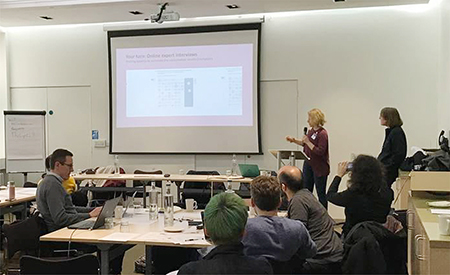
Figure 1. The Shape-shifting workshop.
Set-up of the final engagement workshop, held in London, March 2023.
The article is structured as follows: we first outline the rationale for the interdisciplinary development of the Shape-shifter method, then report on its implementation in a workshop, and finally discuss the findings and directions for further development. These contributions are presented from the perspective of an interdisciplinary team of sociologists, designers, and data scientists. Throughout, we use the pronoun “we” to emphasize collaboration across disciplines, signalling that tasks were not simply delegated but developed collectively through discussion.
Designing for Problematization: An Interdisciplinary Approach
In this section, we describe how the design of our device involved translating—and physicalizing—key concepts from STS and Design into a socio-material setting for the participatory evaluation of AI & Society controversies.
Public Problems Definition through Participation
Participation in defining public problems at the intersection of science, innovation, and society has long been recognized as central to democratic legitimacy (Directorate-General for Research and Innovation, 2007). Mechanisms such as public consultations, hybrid forums (Callon et al., 1986) and the extended peer community (Funtowicz & Ravetz, 1991) gave form to this idea, defining participation as a precondition for legitimate problem definition. More recent work in STS emphasizes issue formation as a dynamic for organizing publics in digital societies marked by participatory culture (Ananny, 2024; Marres, 2007). From this perspective, publics do not pre-exist but emerge alongside contested issues, through material practices of engagement. This shifts attention from representation to problematization, highlighting the role of socio-material practices in articulating public issues (DiSalvo, 2009). Our work builds on these traditions while recognizing that recent AI controversies demand a more critical perspective. McKelvey et al. (2021) and Ricci et al. (2022) found that media coverage of AI is dominated by promotional industry discourse, with civil society perspectives marginalized. Policy analyses in Germany and the UK reveal that governments favor “pro-innovation” approaches, positioning the state as an enabler rather than a creator of problems (Liebig et al., 2024; Roberts et al., 2023).
In contrast to problem-centered approaches (Stirling, 2008), such strategies leave unresolved how risks identified by publics and experts feed into regulatory framings (Marres et al., 2023). This makes it difficult to surface public problems in AI through descriptive controversy analysis alone. To address this, Marres and colleagues (Marres et al., 2024) introduced controversy elicitation as a proactive approach that identifies emerging or hidden issues with the capacity to problematize AI across innovation/society interfaces. Rather than limiting inquiry to observing debates as they unfold, this approach calls for settings that actively invite publics and experts to articulate overlooked controversies. This expands the role of design methods in controversy analysis: the challenge is not only to observe but to create socio-material situations where participants can articulate what the controversy is “really about.”
Design research has also engaged with this challenge, often in dialogue with STS (DiSalvo, 2009; Kimbell, 2005). Scholars have developed methods for object-oriented publics (Sanders & Stappers, 2008; Vargas et al., 2022) and design for public debate (Kerridge, 2016; Keshavarz & Maze, 2013), shifting focus from producing solutions to framing problems (Dunne, 2008). Other contributions highlight design’s role in facilitating issue formation (de Mourat et al., 2020; DiSalvo, 2009) and problem definition (Blyth et al., 2011; DiSalvo, 2009; Lenskjold et al., 2015). Together with other interdisciplinary contributions (Dantec & DiSalvo, 2013; Marres et al., 2018), these works extend the role of design beyond producing solutions to facilitating the ongoing articulation of issues. In contrast to speculative design (Dunne & Raby, 2013), which often operates within hermeneutic frameworks or policy labs that focus on solutions (Ricci, 2019), this work seeks to develop socio-material devices that can facilitate public problem articulation through participatory processes. This objective aligns with the broader aims of social design: the active reorganization of social relations through material practices (Kimbell, 2021; Tonkinwise, 2016).
An Interdisciplinary Operationalization of “Shape” To Facilitate Participatory Evaluation
The participatory method proposed in this paper implements this wider agenda by elaborating three different techniques for the analysis of AI controversies developed across Design Research and STS, as follows: 1) data visualization, 2) inventive indicators, and 3) open prototypes. In this subsection, we describe these three elements and how we combined them in our Shape-shifter method.
Data Visualization and Controversy Shapes
Building on the shared view in STS and Design that data visualization techniques can be used as evaluative devices (Mauri & Ciuccarelli, 2016; Venturini et al., 2015; Venturini & Munk, 2022), in earlier stages of the research, we had developed visualizations of AI-related controversies that we had identified through an online consultation with experts, activists, policy-makers, and artists working on AI & society issues (Marres et al., 2024). As part of this work, we visualized Twitter conversations related to a selected set of five AI-related controversies that our analysis of the consultation responses indicated were especially prominent in the UK context during the relevant period of 2012-2022 (Table 1; for a more detailed discussion of this research design, see Marres et al., 2024).
Table 1. English-language AI & Society controversies selected for in-depth analysis and participatory engagement in the UK by the Shaping AI project.
| Name | Main topics and research publications |
| COMPAS | Algorithmic discrimination in judicial systems sparked by the ProPublica (Angwin et al., 2016) report "Machine Bias." |
| NHS+DeepMind | Data sharing between UK public sector hospitals and big tech was sparked by the Powles and Hodson (2017) paper on Google DeepMind research in the Royal Free. |
| Facial recognition (Gaydar) | Machine learning-based image analysis to predict sexual orientation sparked by Wang and Kosinski (Wang & Kosinski, 2018). |
| Large Language Models (Stochastic Parrots) | Bias in large neural network models for encoding and generating text, sparked by Bender et al. (2021), "On the Dangers of Stochastic Parrots." |
| Deep Learning (DL) as a solution for AI | Deep Learning—the use of trained multilayer neural networks with large numbers of weight parameters—has the capacity to sustain the claims of AI research (Marcus, 2018). |
The analysis of these five AI controversies on Twitter focused on conversations, captured through the Twitter Academic API. We visualized these conversations as an aggregated set of reply chains and rendered these as spatial blocks in space with depth (indicating the overall length of the conversation’s longest thread) and width (indicating the highest number of branching threads originating from an initial tweet) using Multi-Dimensional Scaling (MDS) visualization (Buja et al., 2008) and D3.js, an open-source JavaScript library for visualizing data. For example, Figure 3 represents the shapes of conversations on Twitter about COMPAS, the predictive algorithm used in US courts to assess recidivism risk, and which was found to be racially biased 6 (Angwin et al., 2016).
This interdisciplinary approach allowed us to characterize—by comparing the resulting overall shapes—different controversies about AI as wide (conversations including many responses from different users) or deep (sustained engagement among users in long chains). In our analysis, these visual controversy shapes thus helped to render socio-epistemic features of controversies, i.e., as inclusive (wide, such as the one in Figure 2) versus specialist (deep). In the next step, these controversy shapes were visually repurposed by assigning an overall impressionistic “shape” to each controversy based on Twitter conversations (Figure 3).
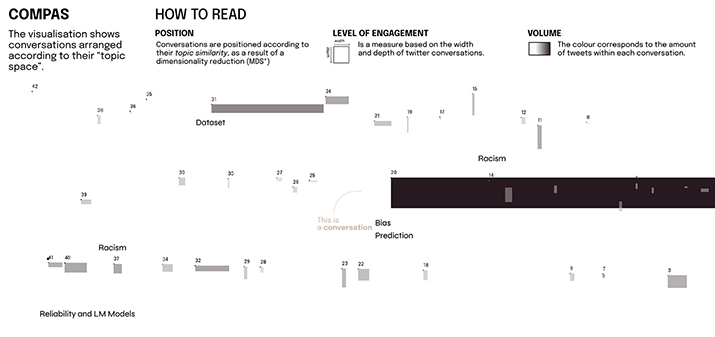
Figure 2. Visualization of Twitter (X) conversations.
Rectangles are positioned in the space according to topic similarity, encoding thread depth and engagement style.
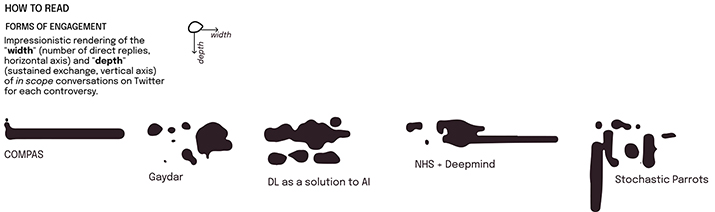
Figure 3. Visualizing Twitter controversies.
Shapes indicate the 'width' (replies) and 'depth' (sustained exchanges) of conversation, derived from MDS.
In subsequent online interview sessions with selected AI & Society experts, we invited our interviewees to offer their interpretations of AI & Society controversies by interacting and manipulating such visual shapes: asking them to move, resize, and annotate the visual shapes we had created to present our controversy analysis in an accessible and interactive format. In this online setting, data visualizations served not only as prompts for debate but also as translation devices. It also invited participants to engage with the notion of the “shape” of controversy as something that emerges through data analysis (Figure 4).
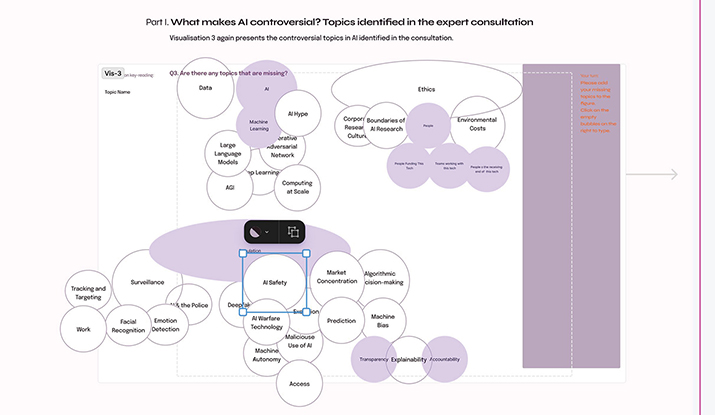
Figure 4. Engaging with Shapes.
Screenshot from an interview session in which participants were asked to move and manipulate a data visualization.
Drawing on these explorations, we continued to develop the notion of the “shape” of controversies not only as a visual heuristic but also as a conceptual tool. The notion of the “shape” was subsequently adopted as the starting point for the design of a socio-material protocol for participatory controversy analysis.
Our underlying speculation was now that the “shapes” and “shaping” of controversy could serve as a device for evaluating or ‘diagnosing’ AI controversies, in response to the broader question: Are recent English-language controversies surrounding AI in “good shape” or “bad shape”? To what degree do they facilitate wide participation (inclusive)? What dynamics of power do they exhibit? This translation of “shapes” from a visualization strategy into an evaluative principle took concrete form in a sketch produced in September 2022 (Figure 5).
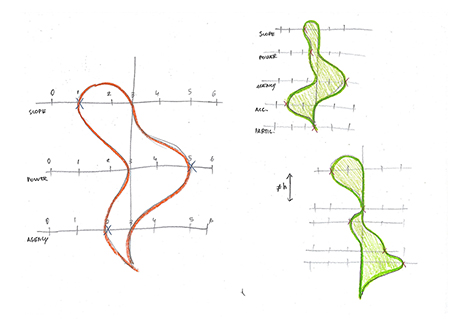
Figure 5. The first visual translation of shapes. Sketch of controversy shaping as a collaborative, evaluative process, conceptualizing axes for participatory controversy shaping (Sept. 2022).
Inventive Indicators as Evaluative Heuristics
Our approach also draws on the heuristic of inventive indicators developed by Marres and de Rijcke (2020). This approach to evaluative metrics moves beyond objectivist framings of indicators as representative of a given reality and proposes to design evaluation as an interactive, generative process. Building on this, we came up with five inventive indicators to structure the evaluative process of controversy shaping: Relevance, Participation, Situatedness, Power, and Solvability. The choice of these five thematic evaluative frames draws on the social theory of material participation (Marres, 2015) and is informed by pragmatist political theory that has also been influential in design (Dixon, 2023). We first tested these frames with design researchers who have special expertise in material participation and conducted a second test with an interdisciplinary group of STS, design, and data visualization researchers at our own university, as described in our annotated portfolio (Poletti et al., 2023). Based on their feedback, we renamed one of the frames: Solvability replaced addressability, emphasizing pragmatic action. We also decided to collapse the distinction between being “affected” and being “concerned” into a single dimension of Participation, to avoid imposing rigid categories and to respect participants’ own ways of defining the themes. We also received feedback that the definitions of the indicators were not fully clear. This is deliberate: the evaluative frames are designed to be interpretable and adaptable, not prescriptive, aligning with pragmatist commitments to enabling participation without closing down the process of meaning-making.
In sketching the process of controversy evaluation as a process of shape-making, we also took literally the idea behind our research project title—Shaping AI. In social studies of technology, the concept of social shaping is a well-known concept for thinking through the ways in which social interests and discursive frames become materialized or scripted into technological systems: the idea that technology do not just derive their shapes from engineering and design decisions but are equally and at the same time shaped through social processes of discursive exchange and the translation of interests (MacKenzie & Wajcman, 1999). By importing this conceptual framework into design research, the approach was transformed into a methodological aspiration for what Daniela Rosner (2018) calls design inquiry: “the crossing of social science sensitivities with the imagination of design” (p. 365). This methodological move also positions our work within the emerging field of data physicalization (Bae et al., 2022; Jansen et al., 2015), which explores how abstract data can be rendered into tangible, manipulable forms. The Shape-shifter adapts this principle by treating evaluative indicators as axes along which controversies can be materially constructed, thus making structured qualitative data both quantifiable and physicalizable.
Open Prototyping and Material Practice
In fleshing out the participatory process of shaping and re-shaping controversies, inspiration was drawn from a third methodological principle: open prototyping (Hemment, 2020). There is no single definition for the role of prototypes in design research (Barzilai & Ferraris, 2023; Stappers & Giaccardi, 2014), but it can be described as a design practice that engenders favorable conditions for ongoing negotiation (Björgvinsson, 2008), where openness is built in by design. While some authors view prototypes as refined physical or digital artifacts (Pei et al., 2011), others consider them as design-thinking enablers (Lim et al., 2008) or tools for building to think (Coughlan et al., 2007). While some use prototypes to test established hypotheses, for others they serve to facilitate open-ended discussions and reflections, reflecting their varied roles (Stappers, 2013) and temporal dynamics (Björgvinsson et al., 2010). Finally, some highlight prototyping’s role in accelerating development (Coughlan et al., 2007), but others value ‘slow’ prototyping, which creates spaces that provoke discussion and controversy (Björgvinsson et al., 2010). The latter distinction is particularly pertinent in the context of emerging design research branches such as service design (Campo Castillo & Rizzo, 2020; Kimbell & Bailey, 2017), design fiction, and speculative design (Dunne & Raby, 2013, pp. 88-138).
Design research has shown that materials and objects can activate everyday knowledge through research-through-design, making tacit insights publicly shareable (Sanders & Stappers, 2008, pp. 7-8)). Co-design methods utilize material properties to externalize ideas and support dialogue, building on traditions of modeling invisible systems (Lockton et al., 2020; Nissen & Bowers, 2015; Yaneva, 2009). Such material practices help participants move beyond institutional roles, question norms, and adopt a more participatory stance (Khan et al., 2020). While the diagnostic notion of “shape” was central, these approaches also highlight the generative potential of collaborative shaping.
Designing Material Gestures of Evaluation
The participatory method presented here integrates design approaches—open prototyping—with a methodology under development in STS—inventive indicators—while also taking inspiration from data visualization techniques used in controversy mapping. Within this framework, physical representations of data can be deployed as open prototypes, serving as tangible representations of controversial issues. Scripted manipulations of these prototypes by participants can facilitate the collaborative evaluation of such issues. This section introduces the principal elements of the Shape-shifter method before describing its implementation in a workshop setting.
The shaping and re-shaping device was designed to let participants express their views on AI controversies through material gestures. Using an evaluative grid based on five inventive indicators, groups collaboratively built unique controversy “shapes.”
However, rather than relying on a fixed standardized scale, we decided to implement the axes of evaluation in a more open-ended way. We did not initially offer a precise definition for each indicator, nor did we provide a numeric scale (i.e., from 1 to 5). Instead, we provided only general labels as prompts, marking the scope of each indicator, which ranged from minor issues to major harms for Relevance, from experts to public in case of the axis of Participation, local to global for Situatedness, few and many to encode who are responsible for Power, and easy to hard for Solvability (Figure 6) 7.
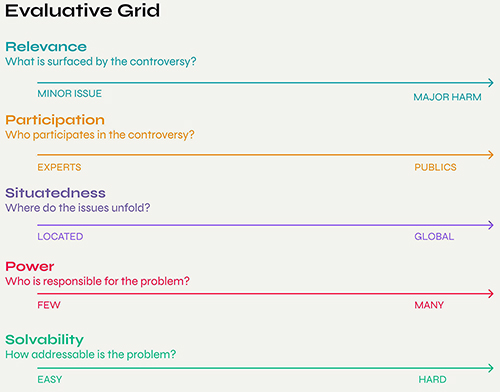
Figure 6. The evaluative grid.
Our five inventive indicators, to be placed on each participant’s table, will serve as axes of evaluation during the elicitation process.
After settling on an evaluative grid with five axes, we briefly considered using sliders but opted instead for more intuitive, decisive gestures. Participants would indicate their stance on the controversy by cutting a cardboard strip to represent their position along each axis. They would then stack these strips of different lengths onto a nail, gradually creating a cumulative shape (Figure 7).
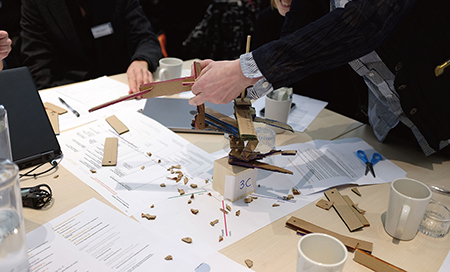
Figure 7. The gesture of stacking. The very act of stacking the cardboards on the wooden nail.
We thus created a material indicator akin to the Pindices designed by Kimbell (Kimbell & Barry, 2005). Participants were asked to cut and stack cardboard strips along the evaluative axes to indicate their positions, and to annotate each strip with a short. This combination of material gestures and discursive positioning enabled the sharing of interpretations and supported recall during analysis. Importantly, the dual mode of contribution created an iterative evaluative process. Each cut and annotation opened up opportunities for re-interpretation, provided reference points for subsequent reshaping, and allowed participants and researchers to connect discursive reasoning with the material controversy shapes that we tested during a recent workshop.
Designing the Method: The Shape-shifter Device
An important consequence of approaching public controversy about AI as an object of elicitation is that it reminds us that issue articulation is an inherently challenging activity. Notwithstanding the efforts of experts and activists to get AI & Society issues onto public and political agendas, it is often not easy to understand how AI presents a problem for society, insofar as naming “bias” or “worker exploitation” as the problem does not in itself clarify how AI participates in that problem. The formulation of AI and Society problems requires the mobilization of experience and knowledge; it requires work of explicitation, the efforts involved in connecting facts with convictions and experienced challenges, on the edge of existing knowledge (McNally, 2026).
This is why, for us, designed socio-material settings for debate play such an important role in enabling public deliberation about AI: to articulate what is at stake in controversies about science and technology, which is so hard to do when asked straight out, participants—all of us—somehow need to be tricked into iterating and re-articulating what the controversy is “really about.”
What kind of device can activate this type of process of problem definition in relation to AI? How to facilitate a participatory process of problem formulation in relation to AI and Society in ways that, following the “change orientation” centered by social design, open up paths for the translation of knowledge into intervention? In operationalizing our commitment to public debate as a form of creative problem articulation, we arrived at the following guiding question: How do we move from the AI controversies we currently have to the AI controversies we need? How to translate such a process into a participatory activity? We eventually found the answer in the design of a participatory process of shaping and re-shaping AI controversies. Our design-led, participatory method for controversy elicitation then consists of two main stages.
During the first stage of “shaping AI,” participants are asked to work in small groups to assess the state of selected AI controversies and are provided with materials to determine their “shape.” After completing the initial round of shaping, groups discussed their individual contributions and cut thicker strips to represent agreed positions for each indicator. This “agreement” phase encouraged negotiation and synthesis, producing a collective “diagnostic shape” of the controversy. In the second stage, “reshaping AI”, participants were asked to re-evaluate the controversy shape they had created, carving out ways to get the AI controversy in question in a better shape and inserting new features required for AI controversies to come, this time using plasticine designed to allow more freedom and incentivize imagination (Figure 8).
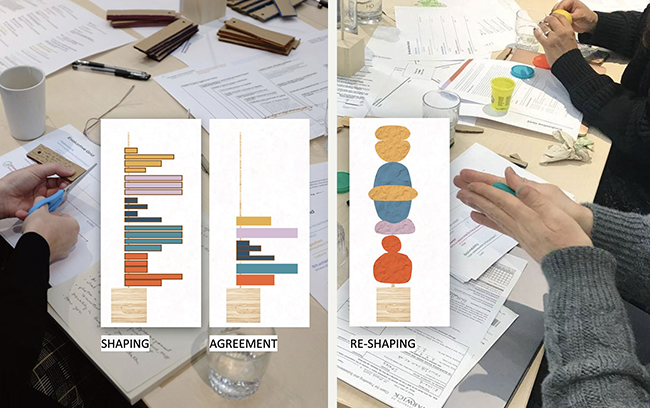
Figure 8. The main phases of our method.
Two pictures show cutting and molding gestures, accompanied by diagrams and a wooden needle for stacking evaluations.
Centering this question enables us to leverage a key methodological strength of design research: facilitating inquiry into social life by bridging the gap between what is and what could be (Rosner, 2018, pp. 67-69). Problem exploration does not necessarily unfold in an eternal present (Ricci, 2019), but rather requires moving back and forth between what is given and what is imagined.
The Shape-Shifting AI Controversies Workshop
As detailed above, our method drew on prior analyses of AI controversies, particularly Twitter debates, to conceptualize controversies in terms of “shape.” Guided by five inventive indicators—Relevance, Participation, Situatedness, Power, and Solvability—and informed by open prototyping principles, we developed the Shape-shifter framework. Using simple materials, this framework was operationalized in a participatory workshop described below.
The Workshop
The workshop was organized in three phases:
- Shaping (Diagnosis): In the first stage of shaping, each group was asked to create the shape of their AI controversy by plotting their positions against the evaluative grid (Relevance, Power, Situatedness, Participation, Solvability). Moving from axis to axis in their chosen order, the participants took turns cutting cardboard strips of the same color as the axis under discussion, annotating their strip with a justification, and stacking their contribution on a central wooden needle structure.
- Agreement (Shared Diagnosis): In the next stage of agreement, experts were asked to ‘finalize’ their shapes, reflecting on the cumulative diagnosis. To indicate their shared position on each indicator, the groups cut a thicker cardboard strip to a single agreed length for each indicator. This moment concluded the diagnosis phase and created a statement of the group’s shared evaluation.”
- Reshaping (what could be): In the last reshaping stage, groups created new shapes for the controversy by reimagining potential features it could have. Using colored plasticine and annotation flags, they carved out ways to get the controversy ‘in better shape’ and speculated on conditions for future controversies.”
Participants
In March 2023, the Shaping AI workshop was held at the Students’ House (London), bringing together 35 participants with diverse expertise in AI and Society. Participants were recruited from respondents to the Shaping AI consultation. They represented a wide range of sectors, including right-based advocacy organizations that campaign on tech issues (Amnesty, Article 19), AI-related government organizations (The Government’s Office for AI, the Office for Statistics Regulation), industry representatives (AstraZeneca, Zoopla) and the arts (Serpentine Galleries; Ambient Information Systems), alongside academics with backgrounds in digital humanities, social science and computer science. This is also to say, for the workshop, we continued to rely on the broad definition of “experts” discussed above. All participants provided informed consent; ethical approval was obtained from the University of Warwick.
The day began with an introduction to the Shaping AI research on AI & Society controversies and the workshop’s guiding question: How do we transition from the AI controversies we currently have to the AI controversies we need? Next, the five AI & society controversies (Table 1) that the workshop groups would be working with (one each) were presented and described: COMPAS, Gaydar, NHS and DeepMind, LLMs (Stochastic Parrots), and Deep Learning as a solution for AI.8
Working in small groups of five to seven people, participants were positioned at different tables, one per each controversy.
Materials
The workshop relied on a carefully designed set of materials that combined documentary resources, evaluative tools, and prototyping elements. The dossier, including text and processed data for each controversy, was shared with participants in digital form a week in advance of the workshop, and a printed version was available on tables for participants to consult. These dossiers contain a timeline of events, an overview of relevant actors, topics, and publications, as well as access to full-text publications from the provided list. At the start of the activity, participants were invited to browse and use these documents, as well as their personal expertise to decide their positionings on the state or shape of the controversy. The dossiers served as a shared knowledge base, enabling participants to anchor their evaluations in documented evidence and their own expertise. Moreover, each table was equipped with a set of bespoke design materials to support the three phases of activity:
- Evaluative grid: A radial diagram displaying the five inventive indicators (Relevance, Participation, Situatedness, Power, Solvability) as axes. Several copies were provided on each table as a constant visual reference.
- Colored cardboard strips, pens, and scissors: Used in the shaping and agreement phases. Participants cut strips to specific lengths to register their evaluative positions and annotated them with brief justifications (Figure 9).
- Wooden base with central nail: Served as the core of the Shape-shifter device. Cardboard strips were stacked onto the nail, producing cumulative controversy “shapes” that embodied individual and group positions.
- Tablecloth with printed axes: Positioned under each wooden base to help orient contributions and align them with the correct indicators (Figure 10).
- Colored plasticine and annotation flags: Used in the reshaping phase to allow more open-ended and imaginative constructions of alternative controversy shapes. Flags enabled participants to inscribe their interpretations directly into the new material configurations.
- Cheat sheets and workshop scripts: Step-by-step instructions for participants, moderators, and annotators, ensuring a consistent process while leaving space for improvisation.

Figure 9. The shaping phase.
The Gaydar table, which deals with the shaping phase, is akin to evaluating the controversy using cardboards and annotations.
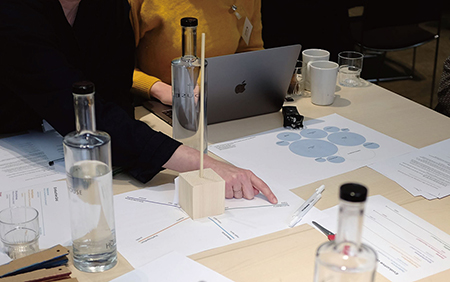
Figure 10. Tablecloth as diagnostic surface.
The tablecloth is placed beneath the wooden structure to support the diagnostic exercise, where controversies are mapped along the axes of the evaluative grid. On the table, participants also used supporting materials drawn from the dossier.
In addition to these core components, supplementary resources supported documentation and facilitation: markers for annotation, printed activity protocols, and a microphone placed at each table to record group discussions. A photographer documented the process, and annotators produced written notes. This material and technical setup provided a scaffold that balanced structure with openness, enabling participants to move from diagnosis to speculation in a way that was both systematic and creative.
Activity
In the first stage of shaping, each group was asked to create the shape of their AI controversies by plotting their positions against the evaluative grid. (Figure 10). Moving from axis to axis (Relevance, Power, Situatedness, Participation, Solvability) in their chosen order, the experts around the table took turns cutting cardboard strips of the same color as the axis under discussion.
Next, they were asked to annotate their strip with the justification for their assessment and stacked their contribution on a central wooden needle structure. This central structure served as the base for both key phases (shaping and re-shaping), supporting participants in starting the activity, and allowed us to keep the materials in one place while making them portable, easy to disassemble for further analysis, and comparable across different evaluations.
This set-up helped participants align their contributions along the appropriate axes while positioning the materials.
Thus, the length of the strips indicates the positions of the participants on that specific axis, while the annotations provided the context and justification of the position. Experts around the table piled strips of different lengths one on top of the other on the central wooden needle. To further facilitate collaborative evaluation and ensure that the act of choosing a position along the axes did not replace meaningful dialogue, we ask participants to write their decisions on the cardboard strips (“Shaping AI” phase).
In the next stage of agreement, experts were asked to ‘finalize’ their shapes reflecting on the different lengths of the strips for each indicator (Relevance, Power, etc.) and reviewing the cumulative diagnosis of the controversy in question these implied. To indicate their shared position on each indicator, the groups were asked to cut a thicker cardboard strip to a single agreed length for each color/indicator (Figure 11). The gesture of indicating position through cutting is thus repeated, but thicker cardboard is used to emphasize that the strips now represent a group position instead of individual ones.
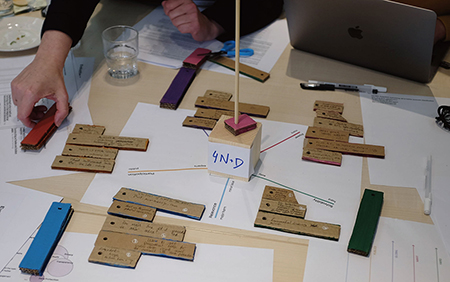
Figure 11. The agreement phase.
The NHS+DeepMind group discusses agreements, arranging cut cardboard, and using thicker pieces, such as pink ones.
In the final reshaping stage, the groups were asked to create new shapes for the controversy by reimagining and redesigning what potential features the AI controversy in question could have, instead of the given controversy they had previously assessed, using plasticine of the same color for each axis (Figure 12). This second gesture was intentionally designed to allow more freedom and foster imagination. However, in this phase, participants were also asked to motivate their material interpretations, writing notes on small paper flags to pin into their abstract plasticine shapes.
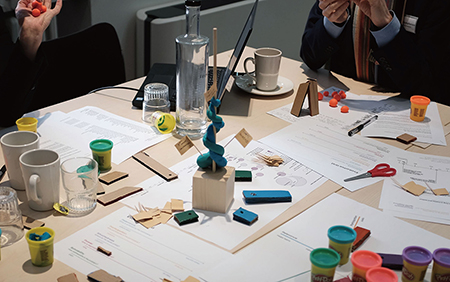
Figure 12. The reshaping phase.
The NHS+Deepmind group is dealing with the reshaping phase of the activity.
At the end of the re-shaping stage, each group was asked to narrate their shapes to the other groups, thus explicating the connection between material representations (shapings and re-shapings) and their discursive evaluations of the controversy in question according to the indicators. All groups could then participate in a broader evaluative discussion about the state of AI & Society controversies, and what interventions, in their view, were required to make AI controversies more effective.
Interpreting Shapes, Shapings, and Re-Shapings of AI Controversies
After the workshop and back in the office, we assembled the material shapes, annotations, photos, and recordings, as well as our individual notes. On this basis, a report was produced that documented the evaluations of the controversy undertaken during the workshop (Marres et al., 2023). This report highlights that, while the AI controversies under scrutiny brought diverse issues of justice in technological societies to wider public attention, they are all marked by concerns over the concentration of power in the tech industry and its control over critical infrastructure. In this article, the focus is on the interpretations of the material shapings and re-shapings of AI controversies undertaken during the workshop, and how these enable an extension and deepening of these findings. Interpretations are offered on three different levels: (1) the overall shapes created by the small groups, (2) the material gestures made by workshop participants, and (3) a more technical interpretation of the shape-shifting activity, referred to as “degrees of modification.”
This analysis extends the interpretive work undertaken by participants during the workshop through annotation, agreement, and narration.
Summing Up Shapes
The interpretative analysis began with a review of photographs of the shapes participants had created during the workshop and produced descriptions of them. Summaries of the principal assessments offered by the groups during the agreement and reshaping stages were then compiled, based on the annotator’s notes taken during the workshop, and triangulated with the agreed-upon shapes. (Figure 13). This exercise surfaced several common patterns. Most notably, power is considered concentrated in a few actors across all controversies. At the same time, many, but not all, controversies were assessed as being dominated by experts. It is thus not necessarily expert power that was found to be dominant. We also note that for most of the evaluation axes, at least some participants opted to indicate ambivalence, offering a “both-and” assessment on these points. Notably, most controversies were situated at both the local and global levels. In an especially playful instance of this, the Gaydar team had manipulated the cardboard into a horseshoe shape during the agreement stage to indicate this double value. The team exploring Parrots made a similar point by using a stair-step shape for the situatedness axis.
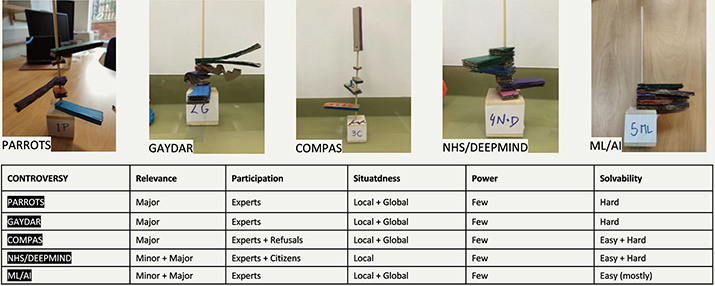
Figure 13. The "Summing up shapes" review. At the top, the resulting agreement phase for each table is displayed. Below is a summary table presenting the overall results of the elicitation process
The annotator notes suggest these ambivalent judgements arose from consideration of the process of controversy formation. Thus, in the case of the NHS-DeepMind controversy, participants expressed ambivalence by using a medium-length strip and by stacking two stripes of different lengths. In doing so, they noted that this controversy began as an expert-led issue, but subsequently, through media reporting and court cases, it came to involve the public. (On participation, the DeepMind controversy in its early stages demonstrates ‘economy of activism dominated by experts vs. experts with very strong public good framing of their expertise 9) These assertions of ambivalence in the controversy shaping are thus evaluative in nature. However, they can also be taken to indicate a certain lack of assertiveness when it comes to formulating a single diagnosis of the state of the AI controversy in question, and the degree to which it was in good shape, or not.
Interpreting Material Gestures
The initial assessment of controversy shapes became more nuanced as a more detailed understanding of the positionings created by the groups was developed. Of key importance in this stage was the interpretation of material gestures and acts of “shaping” performed by individual participants during the workshop. This analysis of material gestures was carried out by reviewing photographs of cuttings (including annotations), shapes and re-shapings, by examining the annotator notes (Figure 14), and by listening to the audio recordings of group deliberations alongside reading their transcription.
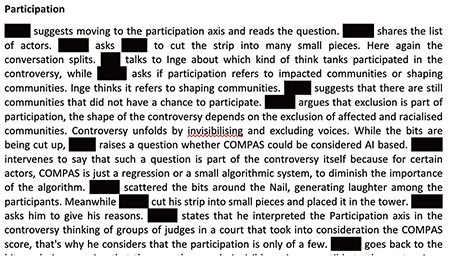
Figure 14. Annotator notes.
An example from the COMPAS group. Participants' names have been censored.
An example of a material gesture invented by workshop participants was the toppling of the COMPAS controversy shape, while drawing an analogy with the toppling of statues during the Black Lives Matter protests, as recorded in the annotator’s notes: “Yeah. What do you think? … Should we pull it down? At some point? […] At the end, it looks like a statue, right?” This intervention highlighted that challenging established narratives may well require symbolic acts. At the same time, this material gesture enabled participants to bring different ontologies into the evaluative space of the shape-shifter device, as when one participant mentioned writing “Columbus” and “White patriarchy” on the cardboard strip.
Material gestures thus emerged during the workshop as powerful interpretative acts that help participants articulate political dimensions of AI controversy. In other cases, material gestures were used to demonstrate complexity. For instance, in the Deep Learning as a Solution to AI group, the contested idea of a simple dimensional scale was challenged by one participant, who decided to cut the material in a way that reflects the nuanced internal framing of the issue, while points out that the multi-dimensionality of machine learning does not align well with a shaping methodology reliant on a limited number of axes of evaluation. Just as in the material expressions of ambivalence created during the agreement stage by bending the cardboard strips, physical modification here offers a metaphor for the challenges participants face in producing their evaluation.
Hacks, or Modifications
Reflections on material gestures led to the creation of a matrix that further developed the interpretations (Figure 15). This visual grid, composed of workshop photos, visually compares the shapings, agreement shapes, and re-shapings across the different controversies and against each indicator, giving further insights into the nuances of each controversy shape. The matrix surfaces some striking patterns. First, there was the issue of degrees of compliance, as some groups followed the workshop protocol more closely than others. For example, while the NHS and DeepMind group cut their strips and annotated these in the precise manner specified in the workshop activity sheet, other groups developed their own techniques for cutting, annotating, and manipulating strips. In some cases, strips were ripped to a pulp (COMPAS) or cut in half, allowing multiple positions to be indicated by a single strip (Deep Learning as a solution to AI).
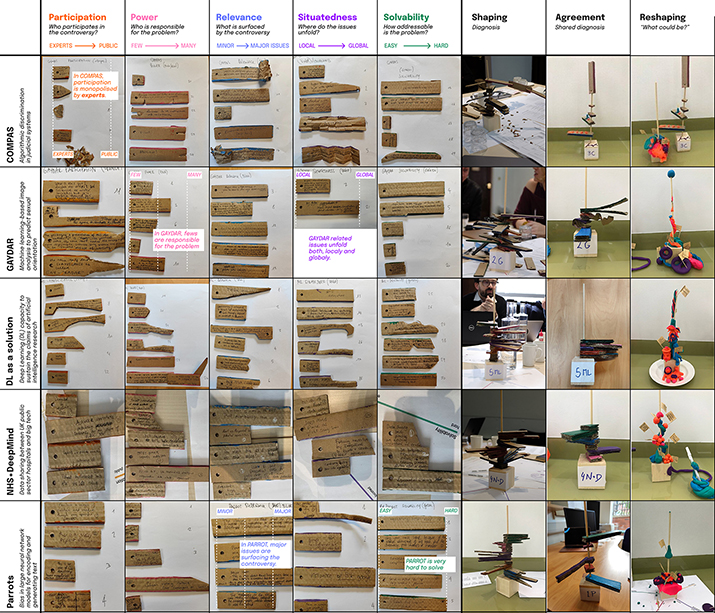
Figure 15. The visual grid.
We created this matrix to analyze shapings and re-shapings across controversies and indicators (click here to enlarge the figure).
Such material disruptions and adaptations of the shape-shifter script are “modifications”. We speculated that these hacks could be viewed as acts of problematization, in relation to varying objects: the modifications in question had either AI and “AI controversy” as their object, or alternatively, controversy analysis and the design protocol of the shape-shifter itself.
All groups performed some forms of modifications, deviating from the initial protocols, either verbally or materially, or creating disruptions in the moment by performative means. For example, in the shaping phase, the COMPAS group chopped cardboard when evaluating the participation axes. The Stochastic Parrots, DL as a Solution to AI, and Gaydar groups used scissors to model cardboard shapes—rather than simply cutting according to a position—to represent their qualitative evaluation of the indicators (e.g., stepped or saw-toothed strips). In the reshaping phase, the DL as a Solution to AI group took a different approach by spreading some of its materials across other tables, creating connections between controversies, rather than confining itself to a wooden block and nail as a limited space for expression.
Levels of Modification:
Problematizing AI, the Controversy and/or Controversy Analysis?
Furthermore, a thematic analysis of the types of modifications created by participants was conducted. This analysis surfaced different types of expression across three levels of modification: 1) AI, 2) controversy, and 3) controversy analysis.
During the workshop, participants frequently employed material modifications to critically reflect on the AI controversies under scrutiny critically. For instance, in the COMPASS case, ambivalence about the relevance of the controversy was expressed through a rolled-up cardboard strip, annotated with notes that questioned power and technological competence (“Long: relevance. Which decision gives tech over lives. Short: What is surfaced (both nothing). Old power structures, tech incompetence.”). The same group addressed the deeper power dynamics that underlie AI and AI controversy by cutting and interlocking cardboard strips to symbolize the interwoven nature of power relations, and included references such as Christopher Columbus (Figure 16).
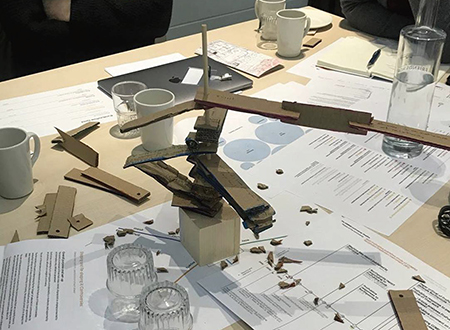
Figure 16. COMPAS, shaping phase.
The shaping phase of the COMPAS table is characterized by the interlocked Power strips.
In the case of DL as a solution to AI, a shape representing an evolving, long-term trend was used to indicate the controversy’s development from an expert-oriented discussion to one that includes more public participation, prompted by the advent of ChatGPT (Figure 17). The amplifying role of ChatGPT emerged as pivotal also when asked to evaluate the Situatedness of the DL as a solution to AI controversy (See strip n°15: “Discussion in particular media over face to face and ChatGPT has globalized it.”, Figure 17).
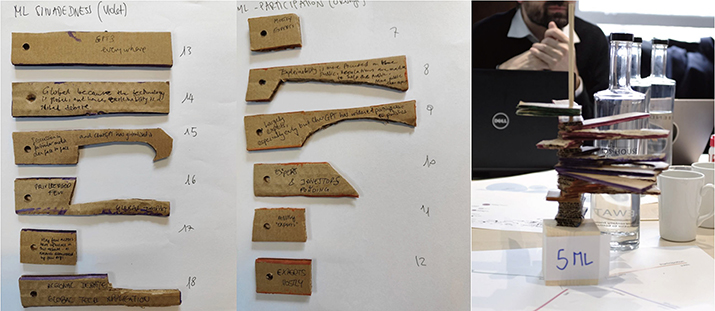
Figure 17. DL as a solution to AI, shaping phase:
On the left, Situatedness cardboards dismantled; strip 15 represents temporality. In the middle: participation cardboards dismantled; strip 8 shows the evolution of participation in the controversy. On the right: the result of the shaping phase.
Other examples of modification aimed at problematizing the controversy arose in the evaluation of the Gaydar controversy. As depicted in Figure 18, the Gaydar group carved out stepped and pointed shapes in the shaping activity, as shown on the left in Figure 18. This initial ambivalence was emboldened when transitioning from the shaping to the agreement phase, where the material shapes expressed this ambivalence not just through cutting but also by modifying strips (see Figure 18, right).
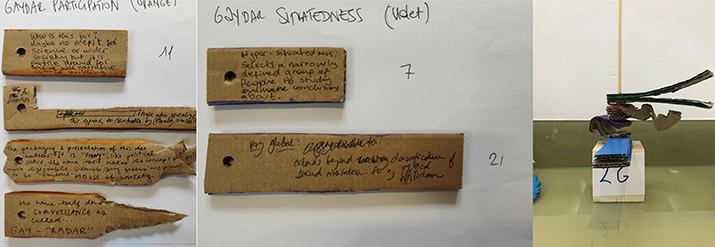
Figure 18. Gaydar, shaping phase.
Some of the dismantled cardboards from the Gaydar shaping phase for Participation and Situatedness are shown on the left. On the right, the agreement phase is depicted, where the material expression of ambivalence emerges.
Participants also sought to expand the evaluative space of controversy shaping and re-shaping through their material modifications. In the DL case, as a solution to the AI controversy, during the reshaping stage, plasticine was distributed across different tables to symbolize the relevance of the deep learning controversy to various other controversies (From the annotator notes: “Participants decide to spread the relevance in the other tables.”). In the Stochastic Parrots controversy table, during re-shaping, blue marbles were disseminated within a “controversy garden,” annotated with the idea that “the solution is outside the system”, indicating that participants were thinking beyond the controversy to consider broader solutions.
Finally, some modifications served as a critique of the controversy analysis method itself. At the COMPAS table, participants expressed dissent through the act of chopping cardboards, symbolizing the exclusion inherent in participation. As the moderator recorded: “[Participant] asks [moderator] to cut the strip into many small pieces. […].” At the DL as a solution to the AI table, participants expressed dissent by skewing a cardboard strip to symbolize how both minor and major issues were brought to the surface, once again challenging the notion of a simple dimensional scale.
Participants thus deployed material gestures in distinctive registers and towards specific ends, taking their exchanges beyond the evaluative affordances of the shape-shifter device. Ambivalence was particularly notable, as participants objected to the binary judgment that the cutting of strips seemed to require of them. Here, the dynamic and temporal nature of controversies was a recurring theme in the discussions. Demonstrations of entanglement were also prominent, as participants found material tricks to challenge the containment of the phenomenon of Tech and Society within the relatively narrow, presentist confines of “AI” and “Controversy.” Anecdotally, we found that material gestures were deployed with special intensity in relation to the axes of Power, perhaps underscoring the intertwined nature of this issue, which does not easily conform to simple categorizations.
Finally, metaphor emerged as a particularly powerful register for material gestures. Participants often began without a clear metaphor, but as the interaction progressed, they found that adopting metaphorical forms helped them articulate their thoughts more effectively (“topping the statue”). This was evident in the COMPAS group, where participants noted that they “[we] didn’t start with a metaphor, but [we] ended up with one.” Overall, the findings from these workshops suggest that creating material modifications of interactional scripts is a powerful way to enhance metaphorical understanding and intervention in controversies.
Discussion
This paper has presented the Shape-shifter device, a material and participatory method for evaluating AI controversies. Our guiding question has been: how do we get from the AI controversies we have to the ones we need?
The Shape-shifter addresses this question by turning existing controversies into objects of collective diagnosis and re-imagination. Through shaping and reshaping, participants are encouraged not only to describe the current state of controversies but also to envision alternative forms that would enable more inclusive, accountable, and situated problem definitions. In this way, the device helps move us away from the controversies we have—often narrow, expert-led, or industry-framed—towards the controversies we need: e that distribute participation more widely, expose power asymmetries, and open up possibilities for democratic intervention.
The Shape-shifter method’s distinctiveness lies in its structured yet open-ended framework, which frames evaluation as a process that is once material and discursive. Our design enables an iterative form of evaluation that organizes the shaping and re-shaping of an evaluative object—AI controversies in the case—as an abductive process (Timmermans & Tavory, 2012). That is, the Shape-shifter allows participants as well as us as researchers to continually move between workshop outputs—such as shapes, recordings, and annotations—and conceptual understandings, treating shaping and reshaping as participatory acts of problem articulation. As a material device for participation, the Shape-shifter thus enables inter-articulation among diverse perspectives, data sources, measures, concepts, and contexts, transcending static frameworks and enabling interaction among human, epistemic, cultural, and technological elements. Our approach is thus explicitly interdisciplinary, prioritizing meaningful exchanges across various domains of knowledge and expertise (Marres & Gerlitz, 2016).
Our approach also addresses perceived constraints on participatory design, which is often limited by rapid problem-solving imperatives, by instead emphasizing continuous reflection and problematization. Annotation and record-keeping played an essential role in this interpretive process, allowing us to document the design journey and identify “levels of modification” that signal the controversial nature of the issues being addressed. These modifications provided valuable indicators of participant engagement and evaluative intervention, with the prototype itself remaining deliberately open, evolving as a “working artifact” that supports dynamic exchange and co-creation. Some may critique this method as being somewhat closed; however, we argue that these constraints are purposeful and indeed generative (Gomart, 2002), allowing participants to engage intensively and reflectively within an organized collaborative process.
While inspired by open prototyping, the Shape-shifter structure adds deliberate constraints that guide participants through a framework of collaborative evaluation, helping to elicit meaningful engagement and foster modification as a form of constructive intervention We created support for this approach by designing a “dispositif of observability:” gestures of shaping, annotating and narrating played a pivotal role throughout this prototyping process, creating a visible record of the evaluative process, which enabled iterative engagement. The creation of this record was also analytically generative, as it enabled us to uncover the “levels of modification” that provide indicators of controversiality.
Unlike other Participatory Data Physicalization cases (Moretti & Mattozzi, 2020; Nissen & Bowers, 2015), the Shape-shifter enables sustained debate while systematically documenting participants’ positions and justifications through annotations, photographs, and a visual matrix that compares individual shapes across evaluative axes and AI controversies.
The levels of engagement that we observed among a diverse set of participants during our AI controversies workshop—which brought together experts with backgrounds in the arts, government, humanities, activism, the sciences, and industry—suggest that our method can facilitate multifaceted exchanges on a complex issue like this. This is not about consensus but about collective interpretation and evaluation, equipping a diverse group to articulate the issues at stake in their own terms (AI in the Street, 2024).
In conclusion, our work seeks to contribute to broader agendas for bringing together public deliberation, policy, and decision-making with participatory design to open up new pathways to material democracy and participation (Collier & Gruendel, 2022; Marres, 2015), which is especially important in complex, ever-evolving fields such as AI (Mariani et al., 2025). Inspired by various traditions, our method is suited to navigating the manifold, interlocking challenges of tech and society today through evaluative inquiry, fostering collective understanding, debate, and intervention in relation to these challenges.
Endnote
- 1. The TV program “The Problem With” on Apple TV Plus in UK: https://tv.apple.com/gb/show/the-problem-with-jon-stewart/umc.cmc.4fcexvzqezr25p9weks6sxpob
- 2. The project page of “People’s Panel on AI”: https://connectedbydata.org/projects/2023-peoples-panel-on-ai
- 3. The event recording of the “Public Voices in AI”: https://digitalgood.net/public-voices-in-ai-launch-event/
- 4. The project page of “Enrolling Citizens: A Primer on Archetypes of Democratic Engagement with AI”: https://datasociety.net/library/enrolling-citizens-a-primer-on-archetypes-of-democratic-engagement-with-ai/
- 5. Project website: https://www.shapingai.org/
- 6. In this visualization, rectangles represent conversations, sized by engagement (reply-chains x longest reply-chains). Wide blocks indicate many replies to a single tweet, while long ones reflect sustained exchanges. Positioned via dimensionality reduction (MDS), rectangles cluster by topic similarity, with related conversations appearing close together.
- 7. By marking positions on axes like relevance, power, situatedness, participation, and solvability, we fulfilled Jacques Bertin’s minimum graphical representation conditions: visual marks and spatial positioning.
- 8. The five controversies are all well-known cases in the field of AI & Society, and all had been put forward and discussed during the Shaping AI consultation and interviews. In this sense, the Shape-shifting workshop was a direct continuation of this preceding research.
- 9. Annotator notes, Deepmind-NHS controversy, Shape-shifting workshop, March 2023.
References
- AI in the Street. (2024, September). AI in the street: Project findings and recommendations. Careful Industries. https://www.careful.industries/ai-in-the-street/research-findings
- Ananny, M. (2024). Making generative artificial intelligence a public problem. Seeing publics and sociotechnical problem-making in three scenes of AI failure. Javnost - The Public, 31(1), 89-105. https://doi.org/10.1080/13183222.2024.2319000
- Angwin, J., Larson, J., Mattu, S., & Kirchner, L. (2016, May 23). Machine bias. There’s software used across the country to predict future criminals. And it’s biased against blacks. ProPublica. https://www.propublica.org/article/machine-bias-risk-assessments-in-criminal-sentencing
- Bae, S. S., Zheng, C., West, M. E., Do, E. Y.-L., Huron, S., & Szafir, D. A. (2022). Making data tangible: A cross-disciplinary design space for data physicalization. In Proceedings of the SIGCHI conference on human factors in computing systems (Article 81). ACM. https://doi.org/10.1145/3491102.3501939
- Barzilai, G., & Ferraris, S. D. (2023). Developing a data classification framework. In S. D. Ferraris (Ed.), The role of prototypes in design research (pp. 9-37). Springer. https://doi.org/10.1007/978-3-031-24549-7_2
- Bender, E. M., Gebru, T., McMillan-Major, A., & Shmitchell, S. (2021). On the dangers of stochastic parrots: Can language models be too big? In Proceedings of the ACM conference on fairness, accountability, and transparency (pp. 610-623). ACM. https://doi.org/10.1145/3442188.3445922
- Björgvinsson, E. B. (2008). Open-ended participatory design as prototypical practice. CoDesign, 4(2), 85-99. https://doi.org/10.1080/15710880802095400
- Björgvinsson, E., Ehn, P., & Hillgren, P.-A. (2010). Participatory design and ‘democratizing innovation.’ In Proceedings of the 11th biennial conference on participatory design (pp. 41-50). ACM. https://doi.org/10.1145/1900441.1900448
- Blyth, S. C., Kimbell, A. L., & Haig, T. H. (2011). Design thinking and the big society: Solving personal troubles to designing social problems An essay exploring what design can offer those working on social problems and how it needs to change. Actant and Taylor Haig. https://www.academia.edu/115642807/
- Buja, A., Swayne, D. F., Littman, M. L., Dean, N., Hofmann, H., & Chen, L. (2008). Data visualization with multidimensional scaling. Journal of Computational and Graphical Statistics, 17(2), 444-472. https://doi.org/10.1198/106186008X318440
- Callon, M., Law, J., & Rip, A. (Eds). (1986). Mapping the dynamics of science and technology. Palgrave Macmillan UK. https://doi.org/10.1007/978-1-349-07408-2
- Campo Castillo, A., & Rizzo, F. (2020). Prototyping in design for policy: Uncertainty and policymakers’ engagement. In Proceedings of the 13th annual international conference of education, research and innovation (pp. 4512-4522). IATED. https://doi.org/10.21125/iceri.2020.0993
- Chuan, C.-H., Tsai, W.-H. S., & Cho, S. Y. (2019). Framing artificial intelligence in American newspapers. In Proceedings of the conference on AI, ethics, and society (pp. 339-344). ACM. https://doi.org/10.1145/3306618.3314285
- Coldicutt, R. (2024). AI safety is a narrative problem. Harvard Data Science Review, (Special Issue 5). https://doi.org/10.1162/99608f92.562ff0f5
- Collier, S. J., & Gruendel, A. (2022). Design in government: City planning, space-making, and urban politics. Political Geography, 97, Article 102644. https://doi.org/10.1016/j.polgeo.2022.102644
- Coughlan, P., Suri, J. F., & Canales, K. (2007). Prototypes as (design) tools for behavioral and organizational change: A design-based approach to help organizations change work behaviors. The Journal of Applied Behavioral Science, 43(1), 122-134. https://doi.org/10.1177/0021886306297722
- Dandurand, G., McKelvey, F., & Roberge, J. (2023). Freezing out: Legacy media’s shaping of AI as a cold controversy. Big Data & Society, 10(2). https://doi.org/10.1177/20539517231219242
- Dantec, C. A. L., & DiSalvo, C. (2013). Infrastructuring and the formation of publics in participatory design. Social Studies of Science, 43(2), 241-264. https://doi.org/10.1177/0306312712471581
- De Mourat, R., Ricci, D., & Latour, B. (2020). How does a format make a public? In M. P. Eve & J. Gray (Eds.), Reassembling scholarly communications: Histories, infrastructures, and global politics of open access (pp. 103-112). MIT Press.
- Dencik, L., Hintz, A., Redden, J., & Treré, E. (2019). Exploring data justice: Conceptions, applications and directions. Information, Communication & Society, 22(7), 873-881. https://doi.org/10.1080/1369118X.2019.1606268
- Directorate-General for Research and Innovation. (Ed.). (2007). Taking European knowledge society seriously. European Commission Publications Office.
- DiSalvo, C. (2009). Design and the construction of publics. Design Issues, 25(1), 48-63. https://doi.org/10.1162/desi.2009.25.1.48
- Dixon, B. S. (2023). Design, philosophy and making things happen. Routledge. https://doi.org/10.4324/9781003194309
- Dunne, A. (2008). Design for debate. Architectural Design, 78(6), 90-93. https://doi.org/10.1002/ad.779
- Dunne, A., & Raby, F. (2013). Speculative everything: Design, fiction, and social dreaming. MIT Press.
- Ehsan, U., Liao, Q. V., Muller, M., Riedl, M. O., & Weisz, J. D. (2021). Expanding explainability: Towards social transparency in AI systems. In Proceedings of the conference on human factors in computing systems (Article No. 82). ACM. https://doi.org/10.1145/3411764.3445188
- Forlano, L., & Mathew, A. (2014). From design fiction to design friction: Speculative and participatory design of values-embedded urban technology. Journal of Urban Technology, 21(4), 7-24. https://doi.org/10.1080/10630732.2014.971525
- Funtowicz, S. O., & Ravetz, J. R. (1991). A new scientific methodology for global environmental issues. In R. Costanza (Ed.), Ecological economics: The science and management of sustainability (pp. 137-152). Columbia University Press.
- Gomart, E. (2002). Towards generous constraint: Freedom and coercion in a French addiction treatment. Sociology of Health & Illness, 24(5), 517-549.
- Gourlet, P., Ricci, D., & Crépel, M. (2024). Reclaiming artificial intelligence accounts: A plea for a participatory turn in artificial intelligence inquiries. Big Data & Society, 11(2), 20539517241248093. https://doi.org/10.1177/20539517241248093
- Hemment, D. (2020). Reordering the assemblages of the digital through art and open prototyping. Leonardo, 53(5), 529-536. https://doi.org/10.1162/leon_a_01861
- Jansen, Y., Dragicevic, P., Isenberg, P., Alexander, J., Karnik, A., Kildal, J., Subramanian, S., & Hornbæk, K. (2015). Opportunities and challenges for data physicalization. In Proceedings of the 33rd annual conference on human factors in computing systems (pp. 3227-3236). ACM. https://doi.org/10.1145/2702123.2702180
- Khan, A. H., Snow, S., Heiner, S., Hardgrove, R., Matthews, S., & Matthews, B. (2020, September 10). The politics of materiality: Exploring participatory design methods, tools and practices. In S. Boess, M. Cheung, & R. Cain (Eds.), Synergy-DRS international conference (pp. 929-946). DRS. https://doi.org/10.21606/drs.2020.246
- Kimbell, L. (2021, March 25-26). Logics of social design. Design as common good online conference. Lucerne, Switzerland. https://ualresearchonline.arts.ac.uk/id/eprint/16854/1/Kimbell_LogicsofSocialDesign_20210120.pdf
- Kimbell, L., & Bailey, J. (2017). Prototyping and the new spirit of policy-making. CoDesign, 13(3), 214-226. https://doi.org/10.1080/15710882.2017.1355003
- Kimbell, L., & Julier, G. (2019). Confronting bureaucracies and assessing value in the co-production of social design research. CoDesign, 15(1), 8-23. https://doi.org/10.1080/15710882.2018.1563190
- Lenskjold, T. U., Olander, S., & Halse, J. (2015). Minor design activism: Prompting change from within. Design Issues, 31(4), 67-78. https://doi.org/10.1162/DESI_a_00352
- Liebig, L., Güttel, L., Jobin, A., & Katzenbach, C. (2024). Subnational AI policy: Shaping AI in a multi-level governance system. AI & SOCIETY, 39(3), 1477-1490. https://doi.org/10.1007/s00146-022-01561-5
- Lim, Y.-K., Stolterman, E., & Tenenberg, J. (2008). The anatomy of prototypes: Prototypes as filters, prototypes as manifestations of design ideas. ACM Transactions on Computer-Human Interaction, 15(2), Article 7. https://doi.org/10.1145/1375761.1375762
- Lockton, D., Forlano, L., Fass, J., & Brawley, L. (2020). Thinking with things: Landscapes, connections, and performances as modes of building shared understanding. IEEE Computer Graphics and Applications, 40(6), 38-50. https://doi.org/10.1109/MCG.2020.3027591
- MacKenzie, D. A., & Wajcman, J. (Eds). (1999). The social shaping of technology (2nd ed). Open University Press.
- Marcus, G. (2018). Deep learning: A critical appraisal (Version 1). arXiv. https://doi.org/10.48550/ARXIV.1801.00631
- Mariani, I., Mortati, M., Rizzo, F., & Deserti, A. (2025). Design thinking as a strategic approach to e-participation: From current barriers to opportunities. Springer Nature. https://doi.org/10.1007/978-3-031-72160-1
- Marres, N. (2007). The issues deserve more credit: Pragmatist contributions to the study of public involvement in controversy. Social Studies of Science, 37(5), 759-780. https://doi.org/10.1177/0306312706077367
- Marres, N. (2015). Material participation: Technology, the environment and everyday publics. Palgrave Macmillan.
- Marres, N., Castelle, M., Gobbo, B., Poletti, C., & Tripp, J. (2024). AI as super-controversy: Eliciting AI and society controversies with an extended expert community in the UK. Big Data & Society, 11(2). https://doi.org/10.1177/20539517241255103
- Marres, N., & de Rijcke, S. (2020). From indicators to indicating interdisciplinarity: A participatory mapping methodology for research communities in-the-making. Quantitative Science Studies, 1(3), 1041-1055. https://doi.org/10.1162/qss_a_00062
- Marres, N., & Gerlitz, C. (2016). Interface methods: Renegotiating relations between digital social research, STS and sociology. The Sociological Review, 64(1), 21-46. https://doi.org/10.1111/1467-954X.12314
- Marres, N., Guggenheim, M., & Wilkie, A. (Eds.). (2018). Inventing the social. Mattering Press. https://doi.org/10.28938/9780995527768
- Marres, N., Poletti, C., Gobbo, B., Terenghi, G., & Castell, M. (2023, April 17). Shifting AI controversies: How do we get from the AI controversies we have to the controversies we need? University of Warwick. https://warwick.ac.uk/fac/cross_fac/cim/research/shaping-21st-century-ai/shifting-ai-report/
- Mauri, M., & Ciuccarelli, P. (2016). Designing diagrams for social issues. In P. Lloyd & E. Bohemia (Eds.), Future focused thinking—DRS international conference (pp. 941-957). DRS. https://doi.org/10.21606/drs.2016.185
- McKelvey, F. (2021). The other cambridge analytics: Early “artificial intelligence” in American political science. In J. Roberge & M. Castelle (Eds.), The cultural life of machine learning (pp. 117-142). Springer. https://doi.org/10.1007/978-3-030-56286-1_4
- McNally, J. (2026). Problem-solving with and within social science methodologies [Unpublished manuscript]. University of Warwick, Coventry, England.
- Moretti, M., & Mattozzi, A. (2020). Participatory data physicalization: A new space to inform. In E. Cicalò (Ed.), Proceedings of the 2nd international and interdisciplinary conference on image and imagination (pp. 1061-1080). Springer. https://doi.org/10.1007/978-3-030-41018-6_86
- Nissen, B., & Bowers, J. (2015). Data-things: Digital fabrication situated within participatory data translation activities. In Proceedings of the 33rd annual conference on human factors in computing systems (pp. 2467-2476). AMC. https://doi.org/10.1145/2702123.2702245
- Novelli, C., Taddeo, M., & Floridi, L. (2024). Accountability in artificial intelligence: What it is and how it works. AI & Society, 39(4), 1871-1882. https://doi.org/10.1007/s00146-023-01635-y
- Pei, E., Campbell, I., & Evans, M. (2011). A taxonomic classification of visual design representations used by industrial designers and engineering designers. The Design Journal, 14(1), 64-91. https://doi.org/10.2752/175630610X12877385838803
- Poletti, C., Gobbo, B., & Terenghi, G. (2023, June 6). The shape of things to come: Workshop report: AI experts share their perspectives on current controversies. The Sociological Review Magazine. https://doi.org/10.51428/tsr.cnlt1114
- Powles, J., & Hodson, H. (2017). Google DeepMind and healthcare in an age of algorithms. Health and Technology, 7(4), 351-367. https://doi.org/10.1007/s12553-017-0179-1
- Ricci, D. (2019). Tensing the present: An annotated anthology of design techniques to inquire into public issues. Revista Diseña, 14, 68-99. https://doi.org/10.7764/disena.14.68-99
- Ricci, D., Crépel, M., Gourlet, P., & Cardon, D. (2022, May 30). AI’s humans: The case of the French press [Paper presentation]. The 72nd annual conference of the International Communication Association, Paris, France. https://sciencespo.hal.science/hal-03690532v1
- Roberts, H., Babuta, A., Morley, J., Thomas, C., Taddeo, M., & Floridi, L. (2023). Artificial intelligence regulation in the United Kingdom: A path to good governance and global leadership? Internet Policy Review, 12(2). https://doi.org/10.14763/2023.2.1709
- Rosner, D. (2018). Critical fabulations: Reworking the methods and margins of design. The MIT Press.
- Sanders, E. B.-N., & Stappers, P. J. (2008). Co-creation and the new landscapes of design. CoDesign, 4(1), 5-18. https://doi.org/10.1080/15710880701875068
- Sloane, M. (2024). Controversies, contradiction, and “participation” in AI. Big Data & Society, 11(1). https://doi.org/10.1177/20539517241235862
- Stappers, P. J. (2013). Prototypes as a central vein for knowledge development. In L. Valentine (Ed.), Prototype. design and craft in the 21st century (pp. 85-97). Bloomsbury.
- Stappers, P. J., & Giaccardi, E. (2014). Research through design. In M. Soegaard & F. D. Rikke (Eds.), The encyclopedia of human-computer interaction (2nd ed., Ch. 41). Interaction Design Foundation.
- Stirling, A. (2008). “Opening up” and “closing down”: Power, participation, and pluralism in the social appraisal of technology. Science, Technology, & Human Values, 33(2), 262-294. https://doi.org/10.1177/0162243907311265
- Timmermans, S., & Tavory, I. (2012). Theory construction in qualitative research: From grounded theory to abductive analysis. Sociological Theory, 30(3), 167-186. https://doi.org/10.1177/0735275112457914
- Tonkinwise, C. (2016). Committing to the political values of post-thing-centered designing (teaching designers how to design how to live collaboratively). Design and Culture, 8(1), 139-154. https://doi.org/10.1080/17547075.2016.1142355
- Vargas, C., Whelan, J., Brimblecombe, J., & Allender, S. (2022). Co-creation, co-design, co-production for public health—A perspective on definition and distinctions. Public Health Research & Practice, 32(2). Article e3222211. https://doi.org/10.17061/phrp3222211
- Venturini, T., & Munk, A. K. (2022). Controversy mapping: A field guide. Polity.
- Venturini, T., Ricci, D., Mauri, M., Kimbell, L., & Meunier, A. (2015). Designing controversies and their publics. Design Issues, 31(3), 74-87. https://doi.org/10.1162/DESI_a_00340
- Wang, Y., & Kosinski, M. (2018). Deep neural networks are more accurate than humans at detecting sexual orientation from facial images. Journal of Personality and Social Psychology, 114(2), 246-257. https://doi.org/10.1037/pspa0000098
- Yaneva, A. (2009). Made by the office for metropolitan architecture: An ethnography of design. 010 Publishers.
